
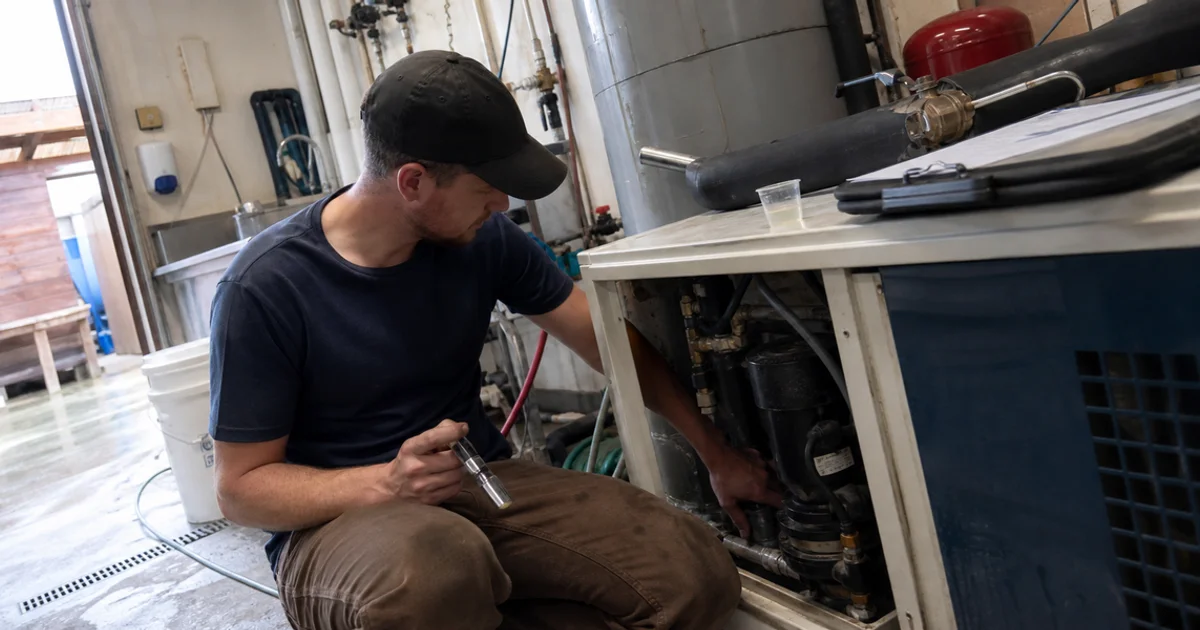
Why Glycol Systems Need Their Own Routine
A glycol chiller has a refrigeration circuit like any other commercial system, so it needs the usual condenser cleaning, charge verification, and electrical checks. But the fluid loop attached to it has maintenance requirements that no walk-in cooler has, and those are the ones that get neglected.
Nothing about a degrading glycol loop is dramatic. Concentration drifts. Inhibitors deplete. Insulation gets damaged during a remodel and never replaced. Efficiency falls slowly, the chiller runs longer, and one day during a crash cool you discover the system cannot keep up.
Our glycol chiller service maintenance visits cover both halves for exactly that reason.
The Fluid: Test, Do Not Guess
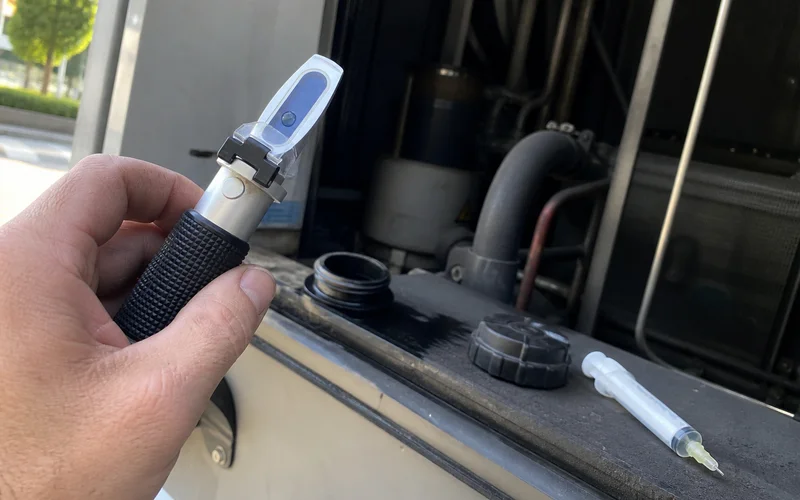
Concentration. Measured with a refractometer, and it tells you your freeze protection point. Too weak risks freezing a line or a jacket. Too strong reduces heat transfer and raises viscosity, making the pump work harder for less cooling. There is a correct band for your lowest operating temperature and the fluid should sit in it.
pH. Propylene glycol solutions become acidic as they age. Acidic fluid attacks the metals in your loop from the inside, and by the time you see evidence of that, the damage is done.
Inhibitor condition. The corrosion inhibitor package is what protects steel and copper. It depletes over time, and depleted fluid is essentially unprotected coolant circulating through your system.
Visual condition. Cloudy, discolored, or particulate-laden fluid is telling you something. Clean fluid looks clean.
Testing takes minutes. Replacing a corroded jacket does not.
The Lines: Insulation and Leaks
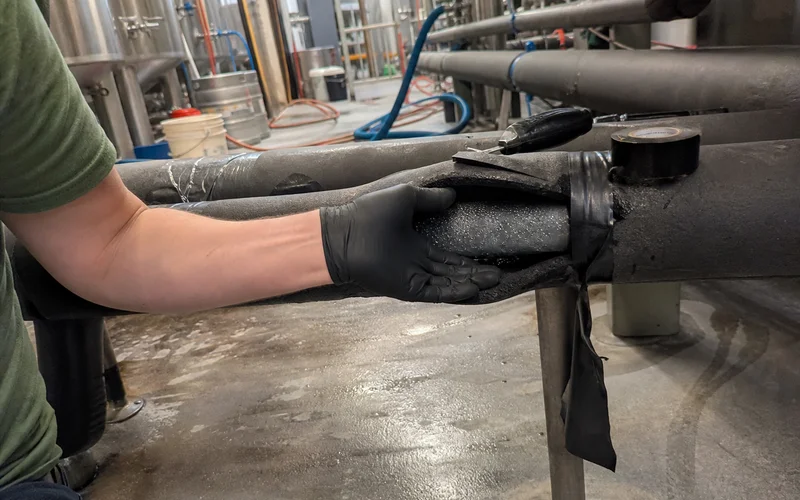
Insulation on the supply and return runs is not cosmetic. Uninsulated line loses cooling capacity between the chiller and the tank, so the chiller has to produce more cooling than the tanks actually need. In a warm cellar that loss is significant.
It also causes condensation. Cold uninsulated pipe in humid air sweats continuously, which means water on your floor, corrosion at fittings and hangers, and a slip hazard in a working cellar.
Remodels are the usual culprit. Insulation gets cut away for access and never restored, and nobody notices because the system still works, just worse.
Leaks are the other line issue. Small leaks at fittings show up as a slowly dropping reservoir level, which people correct by adding fluid, which dilutes concentration, which nobody tests. That chain is how a minor fitting leak turns into a system-wide fluid problem.
The Pump and Flow Balance
| Symptom | Likely cause |
|---|---|
| Far tanks drift, near tanks hold | Reduced pump output or flow balance |
| All tanks drift together | Chiller capacity or refrigeration fault |
| One tank drifts, others fine | That tank’s valve, controller, or jacket |
| Chiller short cycles | Reservoir level, control, or refrigeration issue |
| Cellar floor wet under lines | Damaged or missing insulation |
Flow balance across branches is easy to overlook, particularly in systems that have grown over time. A loop originally designed for six tanks and now serving eleven may not distribute evenly, and the tanks added last are usually the ones that suffer.
Schedule around production, not around convenience
Some glycol maintenance requires taking the loop down. In a working brewery that has to happen in a window you choose, between brews and transfers. We book maintenance against your production calendar rather than dropping in, and urgent faults during active fermentation go to the emergency line.
A Sensible Maintenance Interval
Scheduled visits covering concentration and pH testing, pump and pressure verification, insulation inspection, leak check, chiller condenser cleaning, and controls verification. Cadence depends on production volume and how hard you crash, but a regular interval beats reacting to drift.
For the underlying mechanics of how the loop works and what each component does, see our guide on how glycol chillers keep breweries cold.
Reading the Chiller’s Own Behaviour
The chiller tells you a good deal before anything drifts, if somebody is watching.
Run time. A chiller that used to cycle and now runs continuously has either lost capacity or gained load. Neither resolves on its own.
Supply and return temperature difference. The spread between glycol leaving and returning indicates how much heat the loop is picking up. A narrowing spread on a steady load can mean flow problems; a widening one can mean the chiller is falling behind.
Short cycling. Rapid starts and stops usually point at reservoir volume, control settings, or a refrigeration fault, and they are hard on the compressor.
Reservoir level. Slow decline is a leak. Correcting it with water rather than proper solution is how concentration drifts out of spec.
Logging supply temperature and run behaviour weekly costs almost nothing and turns a vague sense that something changed into a dated record a technician can use.
Preparing for Peak Season
Production peaks and heat waves both stress a glycol system, and both are predictable enough to prepare for.
Ahead of a heavy production run or a hot stretch, the checks worth doing are the same: clean the condenser, verify concentration, confirm pump output, and check line insulation. All four determine whether the system has margin when demand rises.
Systems that fail during a heat wave rarely fail because of the heat. They fail because the heat removed the reserve they had been quietly running on for months.
Tell us your production calendar and we will schedule maintenance ahead of the peaks rather than after them.