Glycol Chiller Service for Craft Beverage
Portland’s craft-beverage scene runs on precise cooling. We service and repair glycol chillers for breweries, wineries, taprooms, and extraction operations, maintaining fermentation and serving temperatures, caring for fluid lines and pumps, and pairing chiller service with CO2 and nitrogen supply so production and pour stay consistent.
How a glycol loop works, and where it goes wrong
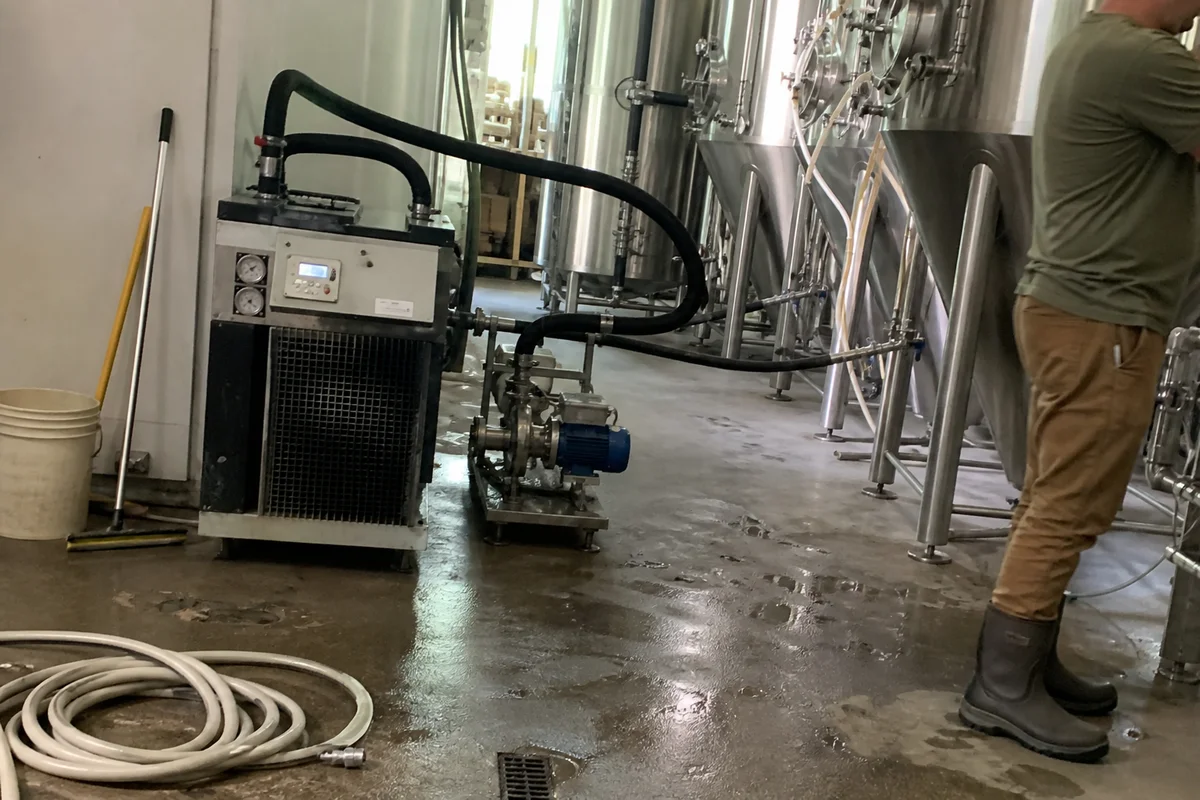
A glycol chiller cools a reservoir of propylene glycol solution. A pump circulates that fluid through insulated lines to jackets on your fermenters, brite tanks, and serving vessels. Each tank has its own control valve and temperature controller, so one chiller holds a dozen different setpoints at once. That is why glycol won over direct-expansion cooling for anything past the smallest setup.
The loop fails in predictable places:
The fluid itself. Propylene glycol is not permanent. Concentration drifts as water gets added, corrosion inhibitors deplete, and pH moves. Fluid past its useful life stops protecting the loop and starts corroding it. Testing tells you where you are; topping off does not.
The pump. Reduced output starves the far end of the loop first, so the tanks furthest from the chiller drift while the near ones hold. That pattern is diagnostic.
Insulation. Uninsulated or damaged line runs bleed cooling capacity, sweat onto your cellar floor, and in cold spaces can freeze. The chiller runs longer to compensate, which costs energy and compressor life.
The chiller’s own refrigeration circuit. Dirty condenser, low charge, failed contactor. The same failures we see on any commercial refrigeration system, just attached to a fluid loop instead of a box.
Diagnosing temperature drift
Drift across every tank usually means chiller capacity or pump flow. Drift on one or two tanks more often means a control valve, a solenoid, a temperature controller, or a balance issue on that branch. We check the loop end to end before condemning the chiller, because replacing a chiller that was never the problem is an expensive way to learn that.
Planning for growth
Adding fermenters adds load, and crash-cooling adds a lot of it at once. Before you buy tanks, tell us what you are adding and we will tell you whether the chiller you own can carry them. That conversation is much cheaper before the equipment arrives than after. We recently expanded our brewery and craft-beverage chiller service, so capacity for larger cellars is there when you grow into it.
If you are comparing cooling approaches for a new build, our guides on how glycol chillers work and glycol versus direct expansion walk through the tradeoffs. And because our gas department delivers CO2 and beer gas on the same account, one company can cover both your cooling and your pour.
What's Included
- Glycol chiller repair and preventive maintenance
- Fluid-line, pump, and pressure inspection
- Glycol concentration testing and fluid replacement
- Fermentation and serving-temperature control
- Cross-supply with CO2 and nitrogen gas delivery