
The Basic Idea
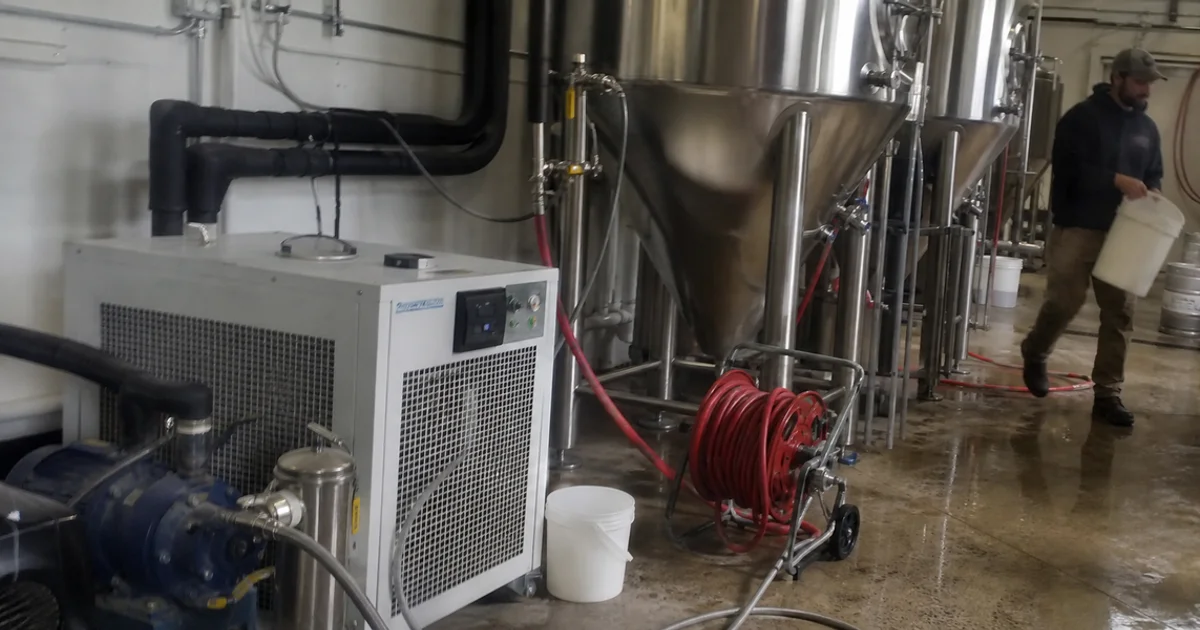
A glycol chiller does not cool your beer directly. It cools a fluid, and that fluid does the work.
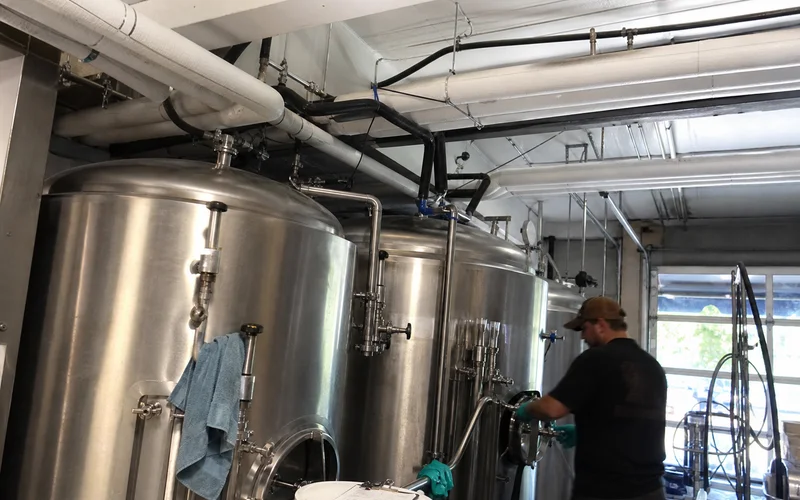
The chiller has a conventional refrigeration circuit, compressor, condenser, expansion device, evaporator, but instead of cooling air in a box, its evaporator cools a reservoir of propylene glycol solution. A pump then circulates that cold fluid through insulated lines to jackets welded onto your fermenters, brite tanks, and serving vessels.
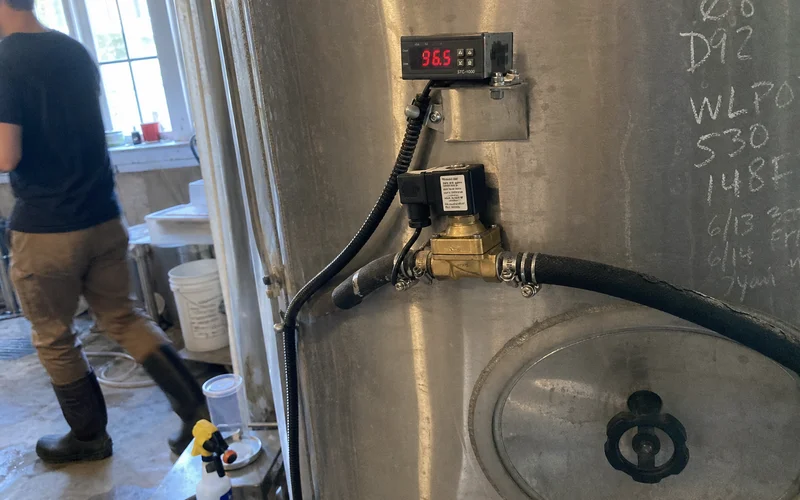
Each tank has a temperature controller and a solenoid valve. When a tank needs cooling, its valve opens and cold glycol flows through the jacket, pulling heat out of the vessel. When it reaches setpoint, the valve closes and the glycol goes elsewhere.
That is the entire concept, and it is why one chiller can hold a dozen different temperatures simultaneously. Everything our glycol chiller service team does follows from understanding that loop.
The Components and What Each One Does
| Component | Job | What happens when it fails |
|---|---|---|
| Chiller refrigeration circuit | Cools the glycol reservoir | All tanks drift warm together |
| Reservoir | Holds fluid, provides thermal buffer | Short cycling, unstable supply temp |
| Pump | Circulates glycol through the loop | Far tanks drift first |
| Supply and return lines | Carry fluid to and from tanks | Efficiency loss, sweating, freezing |
| Line insulation | Prevents heat gain in transit | Chiller runs longer, cellar gets wet |
| Tank jackets | Transfer heat from vessel to glycol | That tank cannot hold temperature |
| Solenoid valves | Admit glycol per tank on demand | One tank stuck warm or stuck cold |
| Temperature controllers | Call for cooling per tank | Setpoint not maintained on that tank |
That table doubles as a diagnostic tool. Which tanks are misbehaving tells you where in the loop to look, which is why the first question we ask is never “is the chiller broken” but “which tanks, and by how much.”
Why Propylene Glycol
Water alone would freeze in the lines at brewing temperatures. Propylene glycol solution stays liquid well below water’s freezing point, transfers heat effectively, and carries corrosion inhibitors that protect the steel and copper in the loop.
Propylene rather than ethylene specifically because of toxicity. Ethylene glycol is a better heat transfer fluid on paper and completely unacceptable in a facility producing food and beverage. Propylene is the standard for good reason.
Concentration matters. Too weak and you lose freeze protection at your lowest operating temperature, risking a frozen line or a damaged jacket. Too strong and heat transfer suffers while viscosity rises, making the pump work harder for less effect. There is a right band and it is worth testing rather than assuming.
Where the Temperature Actually Gets Controlled
This is the part that surprises people new to glycol systems: the chiller does not know or care what temperature your fermenters are at.
The chiller maintains a glycol supply temperature, typically cold enough to serve your most demanding tank. Everything downstream is controlled at the tank, by the tank’s own controller and valve.
Which means a single tank drifting is almost never a chiller problem. It is that tank’s controller, its solenoid, its jacket, or flow balance on that branch. All tanks drifting together points upstream to the chiller or the pump.
Crash cooling is the stress test
Holding a dozen tanks at a steady setpoint is a modest, distributed load. Crash cooling one of them from fermentation temperature to near freezing is a large load concentrated in a short window. Systems that seem fine day to day frequently reveal capacity limits during a crash, which is worth knowing before you schedule two at once.
Why It Beats Direct Expansion for Most Breweries
Scalability is the short answer. Adding a fermenter to a glycol system means adding a jacket, a valve, a controller, and a branch off the loop, provided the chiller has capacity. Adding a fermenter to a direct-expansion setup means adding refrigeration.
Precision is the other. Independent per-tank control across a cellar is straightforward with glycol and awkward without it.
For the full comparison including where direct expansion still makes sense, see our guide on glycol versus direct expansion cooling.
Where the Glycol Loop Meets the Rest of the Building
A brewery’s glycol system rarely exists in isolation. It usually shares a building with a cold room, a keg cooler, and sometimes a taproom’s draft system, and how those interact is worth understanding.
Some breweries run the cold room off the same glycol loop, using a glycol-fed air handler rather than a separate refrigeration system. That consolidates equipment and simplifies service, but it also adds a substantial and variable load to the loop, particularly when the cold room door is being used heavily during packaging.
Others keep the cold room on its own direct-expansion system precisely to protect fermentation capacity from that variability. Neither is wrong, but the choice belongs in the capacity calculation rather than being discovered afterward.
Draft lines are a third consideration. Long-draw systems frequently run a glycol trunk line alongside the beer lines to keep them cold to the faucet, which is another draw on the same loop.
Reading Your System’s Behaviour
Two numbers tell you most of what you need to know day to day.
Glycol supply temperature should sit steadily at setpoint. Rising supply temperature under load means the chiller is falling behind.
Tank setpoint deviation tells you whether the loop is delivering. One tank off is local. All tanks off is upstream.
Logging both weekly turns a vague sense that something feels different into evidence a technician can work from, and it frequently catches a developing problem well before a fermentation is at risk.