
Filtration Is Not One Product
“Get a water filter” is not specific enough to buy anything useful. Commercial ice machine filtration does three distinct jobs, and cartridges vary in which of them they actually perform.
Scale inhibition. A sequestering agent keeps dissolved minerals in solution rather than letting them deposit on the evaporator grid. This is the job that matters most in the Portland area, where mineral content is enough to build scale steadily on unfiltered machines.
Sediment filtration. Particulates get caught before they reach valves and small orifices. Rated in microns, and finer is not automatically better because a very fine filter restricts flow and exhausts faster.
Chlorine taste and odor reduction. Activated carbon removes the chlorine flavor that otherwise ends up in your ice, and in your customers’ drinks.
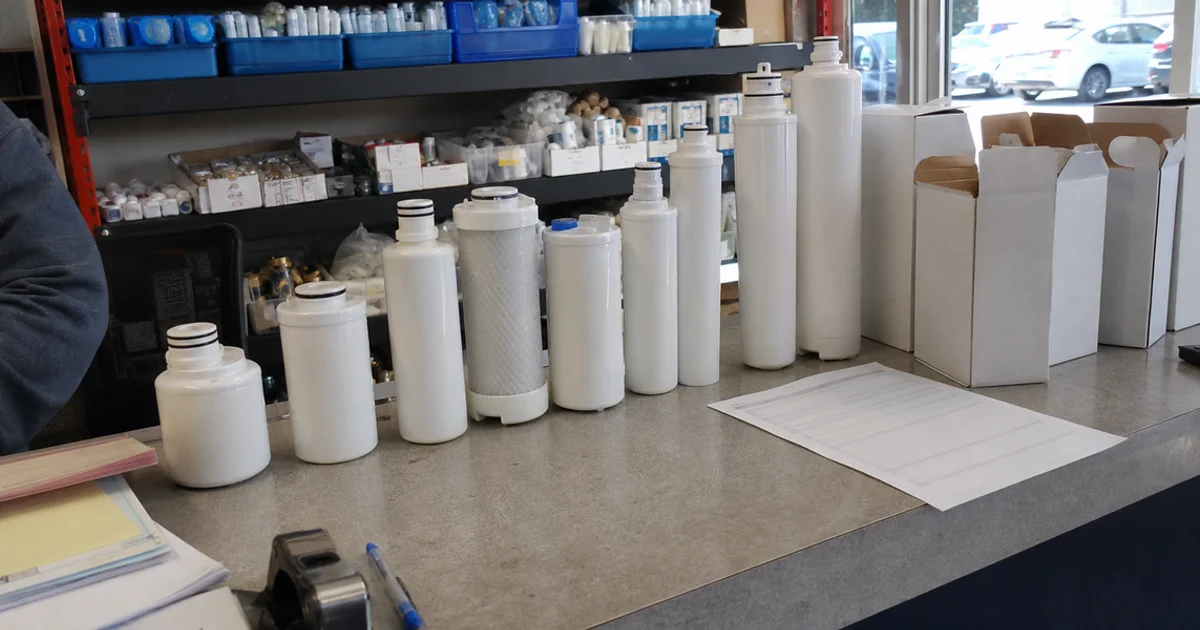
Most commercial cartridges combine all three. Our refrigeration parts and water filters counter stocks the common ones for this reason: the combination cartridge is what nearly every foodservice ice machine actually needs.
Sizing Matters More Than Brand
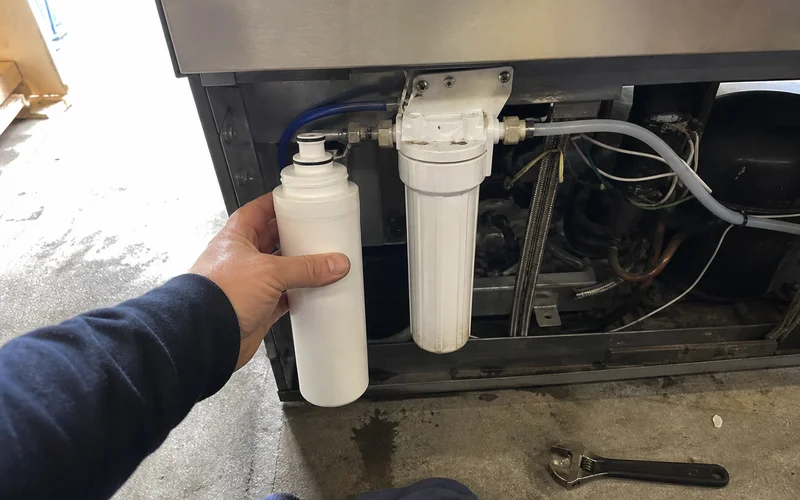
Every cartridge carries a capacity rating, usually expressed in gallons, and a flow rate rating.
A filter rated for a modest undercounter machine installed on a high-production bar machine will do its job perfectly for a fraction of its nominal six-month life, then quietly stop working. The ice looks fine for a while. Scale starts building again. Three months later production is down and everyone blames the machine.
That is the single most common filtration mistake, and it is entirely a sizing error rather than a product quality issue.
To size correctly you need the machine’s daily ice production rating, which is on the data plate, and your actual production volume, which may be lower. Then match the cartridge’s capacity rating against expected throughput over your intended change interval.
| Machine type | Filtration approach |
|---|---|
| Undercounter, low volume | Single combination cartridge, standard capacity |
| Mid-size restaurant machine | Single high-capacity cartridge |
| High-volume bar or hotel machine | High-capacity or dual-cartridge manifold |
| Multiple machines on one supply | Manifold system sized to total demand |
| Known hard water conditions | Step up capacity, shorten interval |
A spent filter is worse than no filter
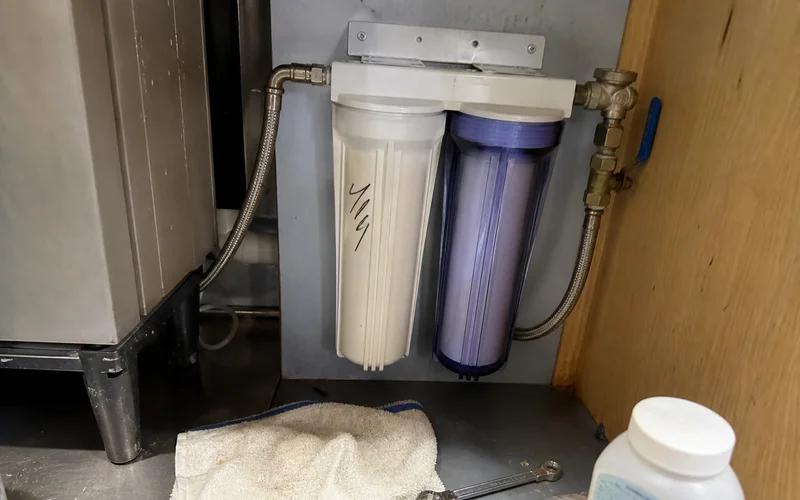
An exhausted cartridge stops removing minerals while looking exactly the same as a fresh one. It also becomes restrictive, reducing water flow to the machine and affecting fill and freeze cycles. Everyone assumes it is still protecting the machine, which is precisely why it causes damage.
Setting a Change Interval You Will Actually Keep
Six months is the common default. Adjust down for high production, hard water, or a history of scale problems.
Then put it somewhere it will not be forgotten. Filter changes are the most commonly skipped piece of ice machine maintenance because nothing breaks when you miss one. Nothing breaks for months. Then you are paying for a professional descale plus a filter instead of just a filter.
Writing the install date on the cartridge with a marker takes five seconds and removes all ambiguity. Putting it on a maintenance agreement removes the need to remember at all.
For the broader picture of how local water conditions drive all of this, see our guide on Portland water hardness, scale, and filter care.
Single Cartridge Versus a Manifold
Small and mid-size machines generally run one cartridge in a single head. It is simple, cheap to change, and adequate as long as the capacity rating matches the machine.
Larger installations, and sites running several machines off one supply, do better on a manifold: two or three cartridges plumbed in parallel or in series. Parallel arrangements increase total capacity and reduce pressure drop, which matters when a single cartridge would otherwise restrict flow. Series arrangements let you stage the filtration, sediment removal first, then scale inhibition and carbon, which extends the life of the more expensive stage.
A manifold costs more up front and less over time on a high-volume site, because change intervals lengthen and you stop replacing an undersized cartridge every eight weeks.
What Filtration Does Not Fix
Filtration handles minerals, sediment, and chlorine. It does not solve every water-related complaint.
Low building water pressure produces fill and freeze cycle problems that look like filter restriction but are not. A partially closed supply valve does the same. Very high total dissolved solids may need treatment beyond a cartridge. And a machine already carrying established scale needs descaling before filtration has anything useful to do.
If a new filter does not restore production within a couple of cycles, the problem is somewhere else and it is worth a service call rather than a second cartridge.
Buying It Right the First Time
Bring or send your machine’s model number and its rated daily ice production. That plus a sense of your actual output is enough for our counter to specify capacity, fitting, and interval in one conversation. We stock the common cartridges, so for most Portland machines a change is a counter visit rather than a special order.