
Start With What Kind of Failure It Is
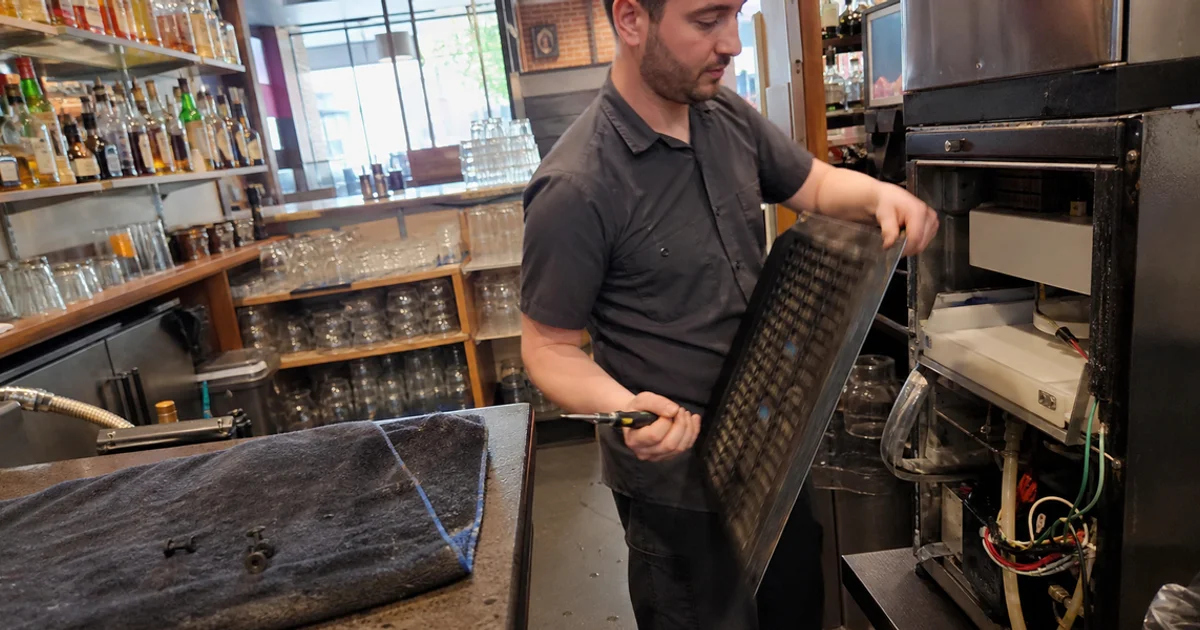
“No ice” covers several very different faults, and identifying which one you have narrows the fix considerably.
No water reaching the machine. Nothing freezing because nothing is arriving.
Water arriving but not freezing. The water path works, the freeze cycle does not complete.
Freezing but not harvesting. Ice forms and never releases into the bin.
Producing, but far less than it should. Capacity loss rather than outright failure.
Each points somewhere different, and telling us which one you are seeing shortens diagnosis noticeably when you call our commercial ice machine repair line.
The Usual Suspects
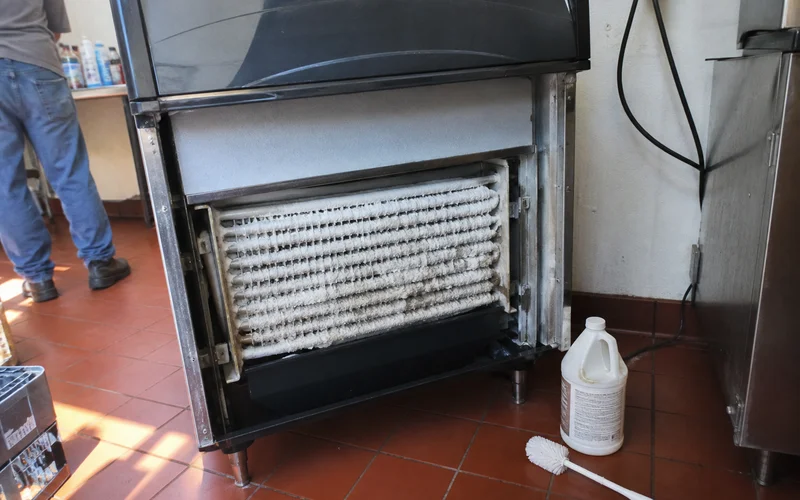
Scale on the evaporator grid. The most common cause in the Portland area by a wide margin. Mineral deposits insulate the nickel-plated grid, so the freeze cycle cannot complete in its allotted time. Production falls, cubes get soft and cloudy, and eventually the machine stops harvesting properly.
Water inlet solenoid failure. The valve that admits water fails closed. No water, no ice. Fairly common and relatively inexpensive to replace.
Dirty air-cooled condenser. Same problem as any refrigeration system: blocked fins mean heat cannot be rejected, head pressure climbs, and capacity collapses. Ice machines in hot kitchens foul quickly.
Harvest cycle fault. A hot gas bypass valve, a harvest sensor, or a control that never triggers the release. Ice forms and stays on the grid.
Bin level control sensor. The machine believes the bin is full and shuts down. Sensors get fouled with scale or biofilm, or simply fail.
Water supply problems upstream. A closed valve, a spent filter that has become restrictive, a kinked supply line, or low building water pressure.
Refrigeration faults. Low charge from a leak, a failed contactor, or a compressor issue. Less common than the water-side causes but they happen.
Checks You Can Safely Run
- Confirm the bin is genuinely not full. Obvious, and it happens.
- Check the water supply valve is open and the supply line is not kinked.
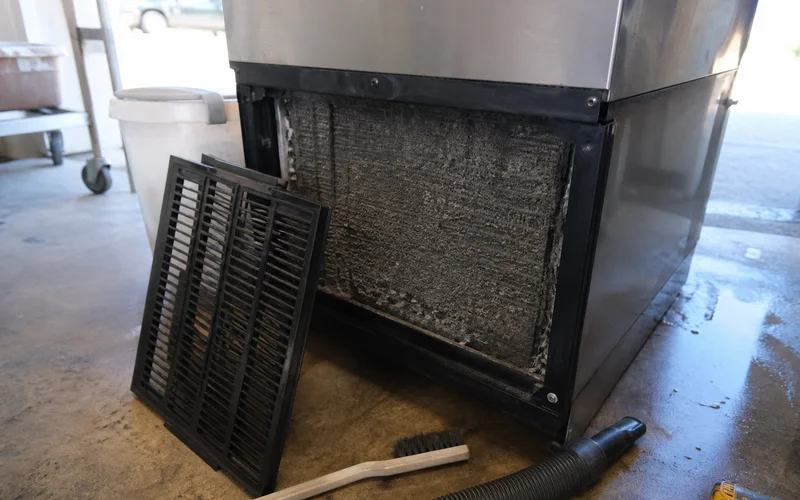
- Look at the condenser. If it is furred with dust and grease, that is at minimum contributing.
- Check the filter age. A cartridge months past due becomes restrictive and starves the machine.
- Confirm power and check the breaker.
- Look at the evaporator grid if accessible. Heavy white deposits mean scale.
- Check for error codes on machines with a display, and note them before calling.
| What you see | Most likely cause |
|---|---|
| No water entering at all | Supply valve, inlet solenoid, restrictive filter |
| Water running, thin or no ice | Scale on grid, refrigeration capacity loss |
| Ice forming but not dropping | Harvest cycle fault |
| Full-looking bin, machine off | Bin level sensor |
| Reduced production only in summer | Dirty condenser, high ambient temperature |
| Cloudy or soft cubes | Scale, short freeze cycle, water quality |
Note the pattern before you call
When production started dropping, whether it degraded gradually or stopped suddenly, and whether ice quality changed first. Gradual degradation almost always means scale or a fouling condenser. Sudden stoppage usually means a component failed. That one detail meaningfully shortens the service call.
Why It Keeps Happening
If this is the second or third time, the underlying cause is probably water rather than the machine. Portland-area water carries enough mineral content to build scale steadily, and without proper filtration a descaled machine simply starts the clock again.
Our guide on Portland water hardness, scale, and filter care covers filter selection and change intervals, which is the actual fix for a recurring production problem. Descaling treats the symptom; filtration treats the cause.
Air-Cooled Versus Water-Cooled
Which type you have changes what to check, and plenty of operators do not know which they own.
Air-cooled machines reject heat through a finned condenser using room air. They are the most common, and they are sensitive to two things: how dirty the condenser is, and how hot the room is. A machine crammed into an unventilated corner or under a counter with no clearance will underperform in summer no matter how clean it is. Manufacturers specify minimum clearances for a reason.
Water-cooled machines reject heat into a water loop instead. They are less affected by ambient temperature, which suits hot kitchens, but they use significant water and their condensers scale internally in exactly the way the evaporator does. A water-cooled machine losing capacity may have a scaled condenser rather than a scaled grid.
If your production drops predictably in summer and recovers in winter, an air-cooled machine with a clearance or condenser problem is the first thing to check.
What It Costs You to Wait
Ice machine faults have an unusual property: the machine keeps working, just less. That makes it easy to absorb the problem operationally by buying bagged ice for a few weeks, and easy to keep absorbing it.
Meanwhile the machine runs longer duty cycles for less output, which stresses the compressor and raises your energy cost per pound of ice. Scale that could have been removed in one service visit becomes heavy enough to need repeated treatment. And the failure eventually arrives anyway, usually on the busiest weekend of the season.
Call while the machine is still producing something. That is a much cheaper service call than the one after it stops.