
Ice Is Food
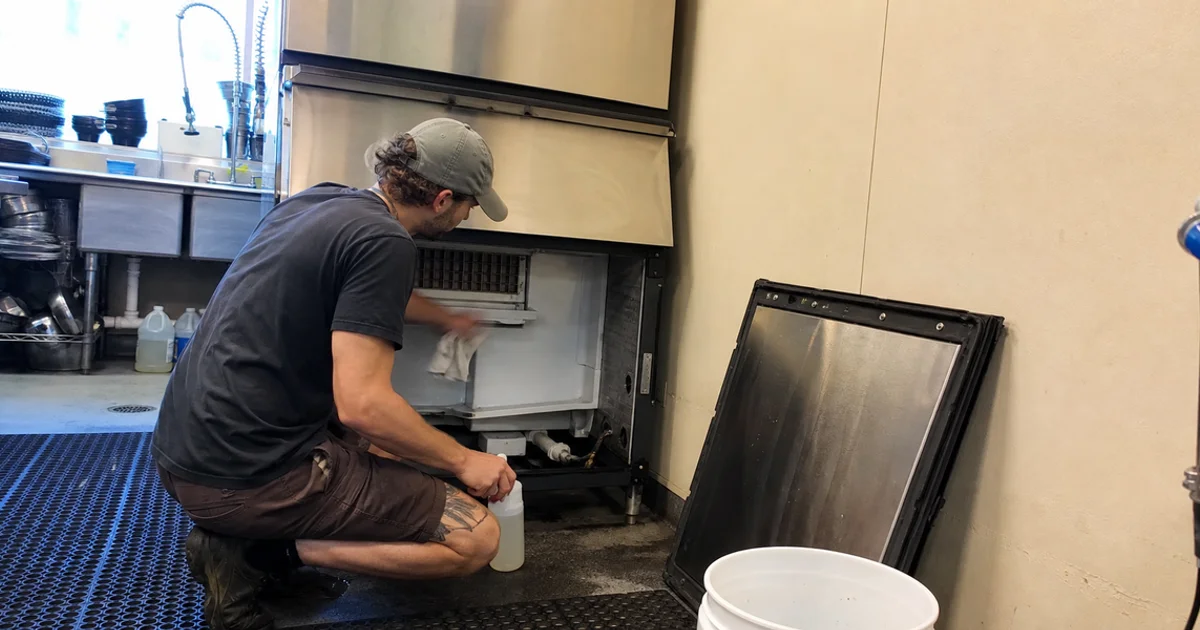
That framing changes how the cleaning conversation goes. An ice machine is a food-contact appliance that runs continuously in a warm, humid kitchen, cycling water across surfaces at temperatures where biological growth is comfortable.
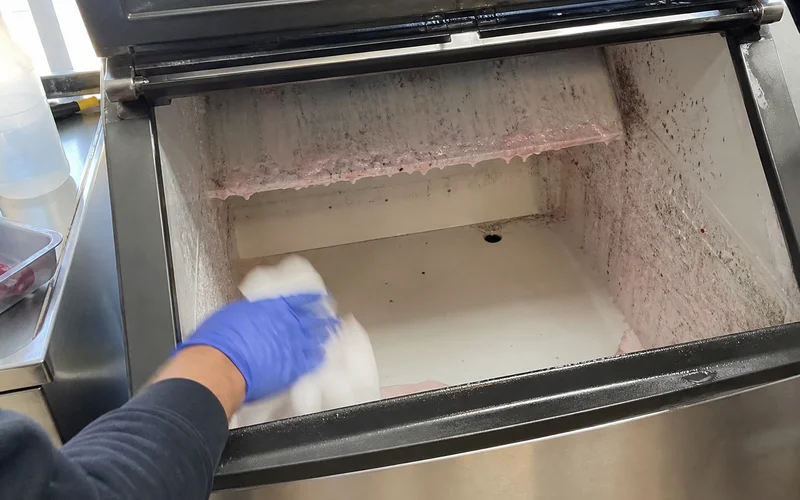
Health inspectors treat ice as a food product, and an ice machine with visible biofilm is a finding. More practically, ice that smells off or tastes wrong ends up in a customer’s glass, which is a problem no amount of good service recovers cleanly.
Cleaning schedules for commercial ice machines are therefore not optional maintenance in the way that, say, touching up paint is. They are part of running a compliant kitchen.
Two Different Jobs
Cleaning removes mineral scale and physical soil from the water path and evaporator grid. Uses an acidic descaling solution appropriate for the machine.
Sanitizing kills biological growth, the slime and mold that colonize wet surfaces. Uses a sanitizing solution, applied after cleaning, in a separate cycle.
Doing one without the other leaves half the problem. Descaling a machine with biofilm gives you clean scale-free surfaces still carrying growth. Sanitizing a scaled machine leaves the deposits that reduce production and give growth somewhere to hide.
Recommended Cadence
| Setting | Interval |
|---|---|
| High-volume bar or restaurant | Quarterly |
| Hard water conditions | Quarterly |
| Moderate-use restaurant | Twice per year minimum |
| Low-use office or cafe machine | Twice per year |
| Any machine showing quality issues | Immediately, then reset the schedule |
Check your machine’s manual for the manufacturer’s specified interval and treat it as a floor rather than a target. Manufacturers set those numbers assuming reasonable water quality, and if yours is harder than assumed, you need to go more often.
Between professional cleanings, staff should handle the bin, scoop, exterior, and door on a routine basis. Scoops in particular get handled constantly and stored badly, and they are a common contamination path all on their own.
Signs you are already overdue
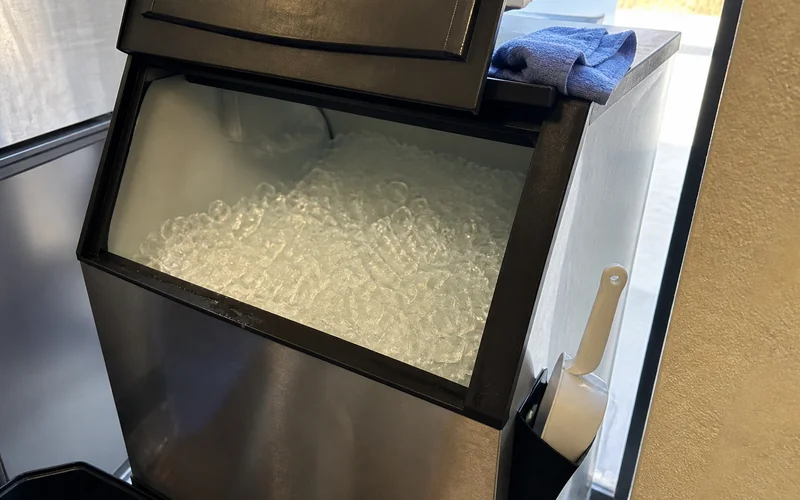
Cloudy or soft cubes. Ice that tastes or smells off. Visible slime on the chute, the bin walls, or the door seal. Falling production. Ice that melts faster than it used to. Any one of those means the interval has already been exceeded, whatever the calendar says.
What a Professional Service Includes
A proper service covers the full water path: removing and cleaning the distribution components, descaling the evaporator grid, cleaning the sump and water lines, sanitizing every food-contact surface, cleaning the bin and chute, checking the condenser and airflow, inspecting the water filter and replacing it if due, and verifying production against the machine’s rating afterward.
Then documentation. A record of what was done and when is what satisfies an inspector asking about your cleaning program, and it is what tells you whether your interval is right.
Making It Happen Reliably
The realistic problem is not knowing the schedule, it is that nothing breaks when a cleaning is skipped. Nothing breaks for months. Then production is down, ice quality is poor, and you are paying for a heavy descale plus a service call.
Putting ice machine cleaning on a preventive maintenance agreement means it happens on schedule without anyone remembering, with filter changes tracked in the same program and documentation generated for your records. For a machine that a bar genuinely cannot operate without, that is a reasonable thing to automate.
Between Professional Visits
There is real work your staff can and should do, and it is not the descaling.
Daily. Wipe the exterior and the door. Store the scoop in a designated holder rather than in the ice, and never let it sit on the bin floor. The scoop is one of the most common contamination paths in a bar and it is entirely within your control.
Weekly. Wipe the bin walls and door seal with a clean sanitizing cloth. Check the condenser is clear of dust and grease. Look at the ice: cloudy or soft cubes are your earliest warning.
Monthly. Check the water filter install date. Confirm the drain line runs freely and is not pooling. Note production against what the machine should be making.
None of that replaces a professional descale and sanitization cycle. All of it stretches the interval between them and catches problems early.
Building the Record
Keep a simple log: date, who did what, what was found. Professional service reports go in the same place.
That record does three jobs. It answers the health inspector who asks about your cleaning program. It tells you whether your interval is actually right, since a machine that looks bad at four months is telling you six months was optimistic. And on ice machines with an extended evaporator warranty, documented water treatment and cleaning is frequently what supports a claim rather than defeating it.
A machine your bar cannot operate without deserves a maintenance record, the same as any other critical asset.