
What a Maintenance Agreement Actually Buys
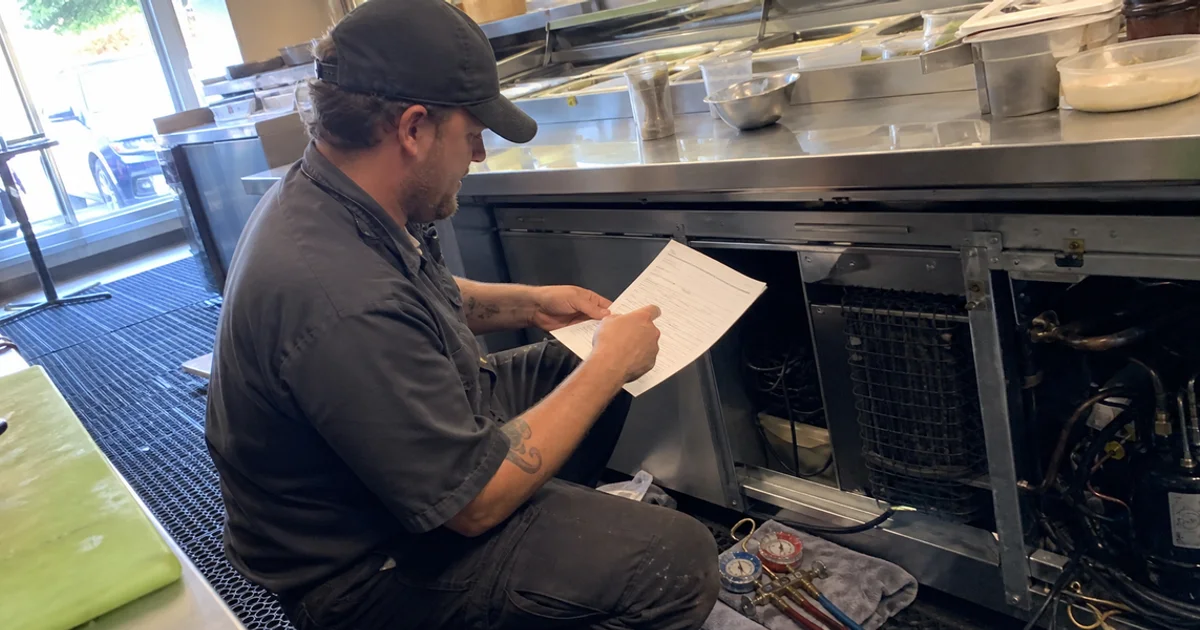
A preventive maintenance agreement, or PMA, is a recurring contract for scheduled inspection and servicing of your refrigeration equipment. In practice it buys three things: fewer failures, cheaper failures when they happen, and a documented service record.
The first is the obvious one and the one people underestimate. Most commercial refrigeration failures we respond to on commercial refrigeration repair calls were visible weeks earlier as a dirty condenser, a flattening gasket, or a defrost sensor slowly drifting out of range. None of those are dramatic. All of them are catchable on a routine visit.
What a Visit Covers
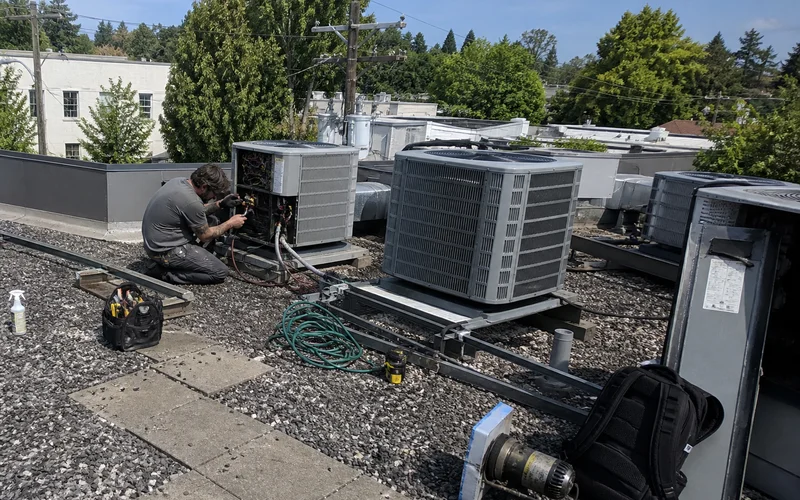
A proper scheduled visit on a walk-in or reach-in includes:
- Condenser cleaning. The single highest-value item. A blocked condenser raises head pressure, shortens compressor life, and is the leading cause of hot-weather failures in Portland kitchens.
- Evaporator inspection. Coil condition, frost patterns, fan motor operation, drain pan and drain line clearance.
- Door gaskets and closers. Seal integrity around the full perimeter, hinge and closer function, sweep condition.
- Defrost cycle verification. Confirming the cycle initiates, runs, and terminates on temperature rather than timing out.
- Temperature and pressure readings. Superheat and subcooling where applicable, box temperature verified against setpoint.
- Electrical check. Contactors, relays, connections, and amperage draw against nameplate.
- Controls. Thermostat calibration and controller settings verified.
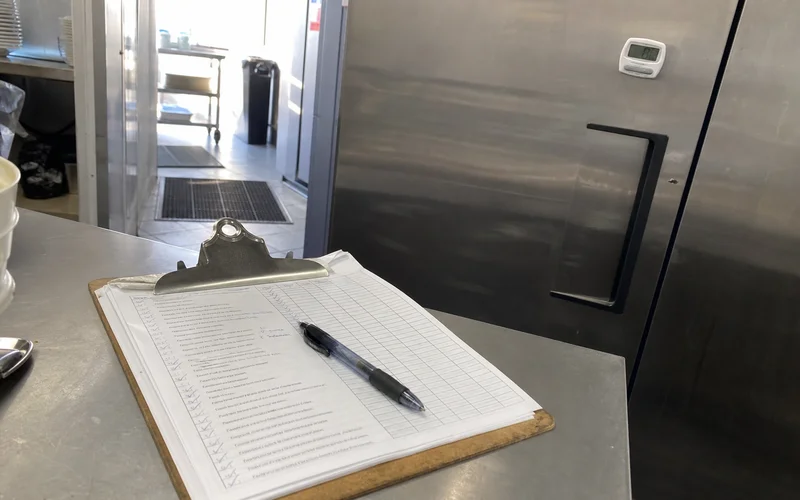
- Documentation. A written record of what was checked, what was found, and what was corrected.
Ice machines add descaling, sanitization, and water filter inspection. Glycol systems add concentration testing and pump verification.
Cadence
| Equipment and setting | Suggested cadence |
|---|---|
| High-volume kitchen walk-in and freezer | Quarterly |
| Restaurant reach-ins and prep tables | Quarterly to semi-annual |
| Ice machine, hard-water or high-volume site | Quarterly |
| Ice machine, moderate use | Semi-annual |
| Healthcare or institutional cold storage | Quarterly, with documentation |
| Backup or low-use unit | Semi-annual |
Quarterly is the sensible default for anything holding significant inventory. Kitchens with heavy grease loads reaching rooftop condensers sometimes justify more frequent condenser cleaning specifically.
Food safety and documentation
Health inspectors want to see that equipment is maintained and that temperatures are monitored. A maintenance agreement generates that paper trail as a by-product. For healthcare, education, and institutional facilities with formal temperature-logging obligations, it is not just convenient, it is part of compliance.
The Cost Comparison
We are not going to pretend maintenance is free. But the comparison is not close, and it is worth spelling out.
A scheduled maintenance visit happens during business hours at standard rates on a planned route. An emergency call happens after hours at higher rates, frequently with a return visit because supplier counters are closed, and frequently with product loss on top.
Add the second-order costs and the gap widens further: a walk-in down during service costs you sales, a health department conversation about holding temperatures costs you time and standing, and a compressor killed by a year of running against a blocked condenser is a major capital item that arrived early.
For most kitchens running several pieces of refrigeration, one avoided emergency in a year covers the annual agreement cost. Two makes it clearly profitable. If you want the underlying rates rather than the comparison, how commercial refrigeration repair is priced breaks down what a scheduled visit and an after-hours call each cost.
What to Ask Before Signing
Ask what is included versus billed separately, particularly whether parts and refrigerant on a scheduled visit are covered. Ask what the cadence is per unit and whether it is adjustable. Ask whether the agreement includes priority dispatch and what rate applies to calls outside the scheduled scope. Ask what documentation you receive after each visit.
If the answers are specific, you are dealing with a company that actually runs a maintenance program. If they are vague, you are buying a discount card.
Ready to price one for your equipment? Set up an agreement and we will scope it against what you actually have rather than a generic package.
What Changes in Practice Once You Have One
Operators who move from break-fix to a maintenance agreement describe the same shift: refrigeration stops being something they think about.
Emergency calls drop. Not to zero, since equipment still fails, but the failures that come from slow degradation, dirty condensers, worn gaskets, drifting sensors, largely stop happening.
Budgeting gets easier. A known annual figure replaces an unpredictable series of emergency invoices. For facilities that have to forecast, that is often worth more than the raw savings.
Repairs get faster. The technician arriving already knows your equipment, its history, and its quirks, because they have been servicing it quarterly. Diagnosis time falls.
Documentation exists. Health inspections, insurance questions, and warranty claims all go better when there is a service record to produce.
Coverage Across Multiple Sites
Multi-location operators frequently end up with a different arrangement at each site, usually because each one solved the problem locally.
Consolidating onto one agreement gets consistent scope and cadence across locations, one point of contact, and equipment history tracked in one place. When a manager moves between sites, the refrigeration program does not change with them.
It also lets us spot patterns. If the same component fails across three of your locations, that is worth knowing, and it is invisible when three different companies handle three different buildings.
Tell us what equipment you have and where, and we will scope an agreement around it rather than selling a package.