

Why This Decision Gets Made Badly
Most repair-versus-replace decisions get made under pressure. The box is down, service is tonight, and the choice is between an expensive repair now and a capital purchase with a lead time you do not have. Under those conditions almost everyone repairs.
That is fine once. The problem is the third or fourth time, when the cumulative spend on a dying unit has quietly exceeded what a replacement would have cost, and you still own the dying unit.
Making the decision deliberately, before the next failure, is worth an hour of thought. Our commercial refrigeration repair technicians give you both numbers on any significant repair for exactly this reason.
The Four Factors That Decide It
Age against expected life. Commercial refrigeration equipment generally runs ten to fifteen years, with self-contained units at the shorter end and well-maintained remote systems at the longer end. Walk-in envelopes, the panels and doors, outlive the refrigeration serving them by a wide margin, which is why replacing a condensing unit on a sound box is often the right answer rather than replacing the whole thing.
Repair cost against replacement cost. The common heuristic: if one repair exceeds roughly half of a comparable replacement and the unit is past two thirds of its expected life, replace. Treat it as a prompt to think, not an answer.
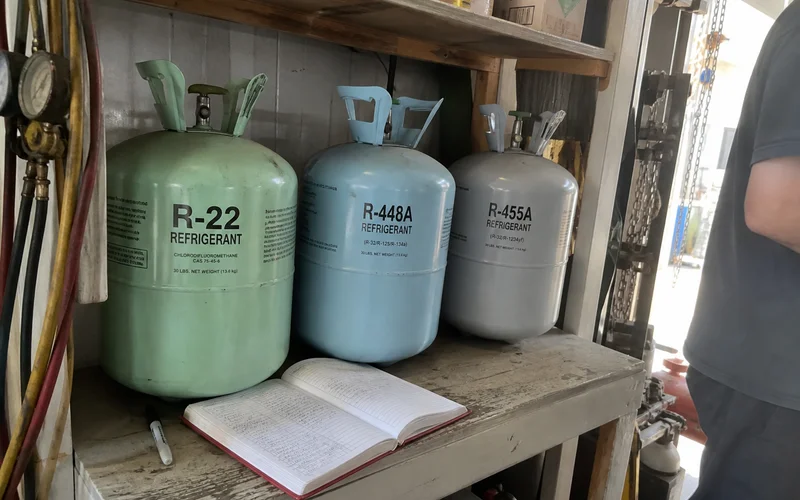
Refrigerant. This is the factor most operators underweight. Equipment running R-22 or R-404A faces a shrinking, increasingly expensive service refrigerant supply. A leak repair that requires a substantial recharge costs meaningfully more on those systems than on a modern one, and that gap widens every year.
Repair history and downtime risk. A unit that has needed three service calls in eighteen months is telling you something. So is the question of what a failure costs you. A walk-in holding your entire weekend inventory is a different risk profile than a backup reach-in, and it justifies a more conservative replacement decision.
A Decision Table
| Situation | Lean toward |
|---|---|
| Unit under 7 years, first significant repair, modern refrigerant | Repair |
| Sound walk-in envelope, failed condensing unit | Replace the condensing unit, keep the box |
| Repair cost above half of replacement, unit past 10 years | Replace |
| R-22 system needing a recharge after a leak | Assess retrofit or replace |
| Third service call in 18 months | Replace |
| Critical box with no redundancy, aging equipment | Replace proactively |
| Non-critical backup unit, moderate repair | Repair |
The middle option people forget
Repair and replace are not the only choices. On a walk-in with sound panels, doors, and floor, swapping the condensing unit and evaporator gives you a modern refrigeration system at a fraction of a full replacement, and lets you move off an obsolete refrigerant at the same time. Ask whether this applies before assuming you need a whole new box.
Efficiency and the Case for Proactive Replacement
Refrigeration is typically the largest continuous electrical load in a commercial kitchen. A modern system with better insulation, electronically commutated fan motors, and current controls uses noticeably less energy than a fifteen-year-old equivalent doing the same work.
That means a proactive replacement is not purely a cost. It has a return, and on equipment running twenty-four hours a day the payback period is often shorter than operators expect. Worth actually calculating against your rates and run hours rather than dismissing.
The proactive version also lets you choose the timing. Replacing a marginal walk-in during a slow February with a planned installation is a completely different experience from replacing it in July after it failed during service.
What to Ask Your Technician
Ask for both numbers: what this repair costs, and what a replacement costs. Ask what refrigerant the system uses and what that means for future service. Ask what else on the unit is likely to fail in the next two years. Ask whether a condensing-unit swap is an option.
If you are working through refrigerant obsolescence specifically, our guide on the R-22 phase-out and low-GWP retrofits in Oregon covers the compliance side and the retrofit options in more detail.
Total Cost of Ownership, Not Just This Invoice
The repair-versus-replace question gets answered badly when only two numbers are compared: the repair quote and the replacement quote. Two more belong in the calculation.
Energy over the remaining life. An aging system with degraded insulation, an original-generation compressor, and shaded-pole fan motors uses substantially more electricity than a current equivalent doing identical work. On equipment running continuously, that gap compounds every month you keep the old unit.
Expected downtime. A unit that has failed three times in eighteen months will fail again, and each failure carries after-hours labor plus whatever product is at risk. If you can estimate that annual cost even roughly, it belongs on the repair side of the ledger.
Add both and the case for replacement usually arrives earlier than the single-invoice comparison suggests.
Timing Is a Lever You Control Only Once
The most expensive version of this decision is the one made at 9 PM during service, when the choice is between an emergency repair and a replacement with a lead time you do not have.
The cheapest version is made in a slow month, with quotes in hand, installation scheduled around your operation, and the old unit still running while the new one goes in.
If you have a unit you already suspect is near the end, decide now rather than waiting for it to decide for you. Ask your technician at the next service visit for a straight assessment of remaining life and a replacement budget. Having that number on file turns a future failure from a crisis into a phone call.
We will give you both figures on any significant repair without being asked.