
The Three Pricing Models
Commercial refrigeration is priced one of three ways, and knowing which one you are being quoted under prevents most billing disputes.
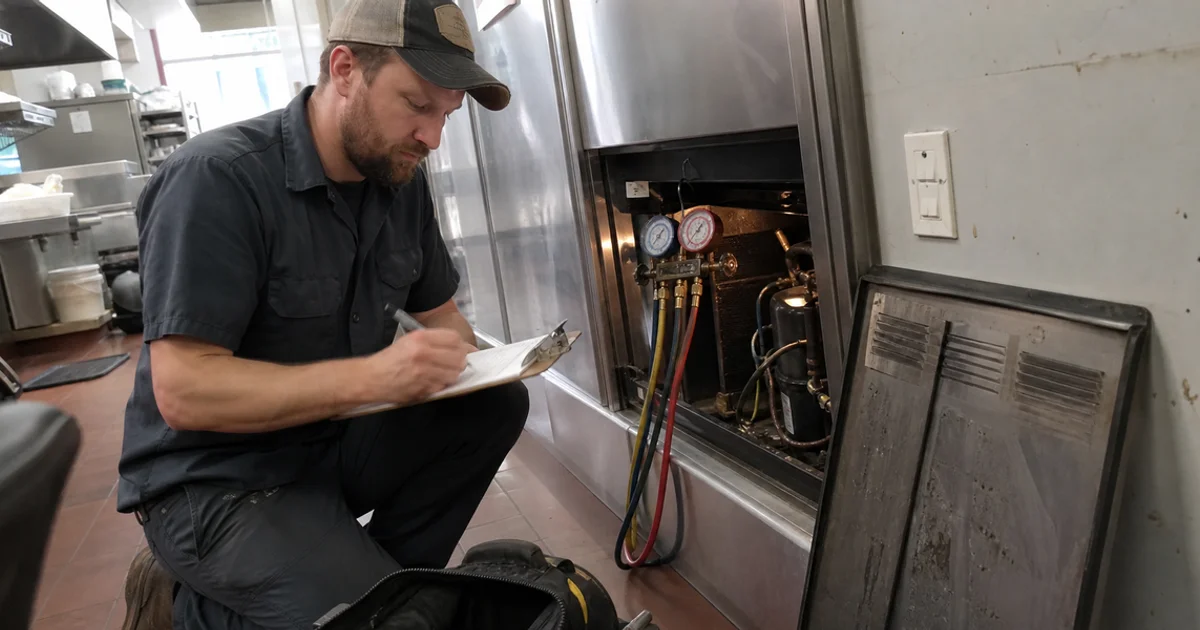
Hourly service call. You pay for the technician’s time plus parts. Diagnosis is included in that time. This is the standard model for repair work where the fault has to be found before it can be priced. Our commercial refrigeration repair service calls work this way.
Flat rate. A fixed price for a defined job. Works well when scope is known up front, a gasket replacement, a scheduled cleaning, a filter change. Works badly for diagnostics, because the company has to price in the possibility that the job turns out to be complicated, and you pay that premium whether or not it does.
Maintenance agreement. A recurring contract covering scheduled inspections, usually with preferential rates and priority dispatch on anything outside the scheduled scope. Shifts spend from unpredictable emergencies toward predictable prevention.
What Actually Drives the Number
Five variables account for most of the range between a small invoice and a large one.
Which component failed. This is the biggest factor by far. A contactor, a door gasket, or a defrost sensor is an inexpensive part and a short visit. An evaporator fan motor is moderate. A compressor is a major component with substantial labor, refrigerant recovery, and often a full system evacuation and recharge.
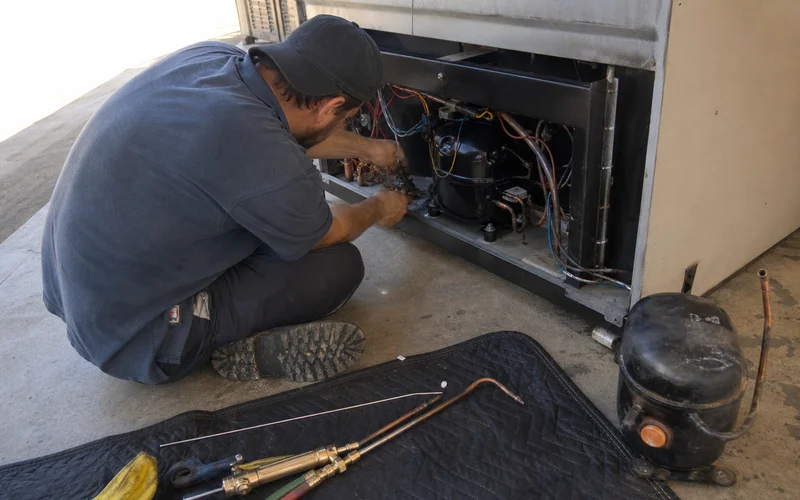
Labor time. Diagnosis on an intermittent fault takes longer than diagnosis on a dead compressor. Brazing line work takes longer than swapping a plug-in part.
Refrigerant. Recovery, evacuation, and recharging all take time and materials. On systems still running R-22 or R-404A, the refrigerant itself is expensive and getting more so as production phases down. This is one reason older equipment costs more to repair than the same job on a newer system.
Access. A rooftop condensing unit that requires ladder access, a roof hatch, and building coordination costs more in labor than a self-contained unit you can walk up to. Tight urban kitchens, restricted loading zones, and escorted access at secured facilities all add time.
Timing. After-hours, weekend, and holiday calls carry higher rates. That is real cost, not a surcharge for its own sake: on-call staffing is more expensive and supplier counters are closed.
Rough Relative Scale
We are not going to publish prices, because a walk-in in a Pearl District basement and a reach-in on a loading dock are not comparable jobs. But the relative scale is useful for budgeting.
| Repair type | Relative cost | Typical scope |
|---|---|---|
| Gasket, contactor, sensor | Low | One visit, stocked part, under an hour of labor |
| Evaporator fan motor, defrost heater | Low to moderate | One visit, part may need ordering |
| TXV replacement, leak repair and recharge | Moderate | Refrigerant work, longer labor, possible return visit |
| Compressor replacement | High | Major component, full evacuation and recharge |
| Full system replacement | Highest | Often the better value on aging equipment |
Ask this before dispatch
“Is this billed hourly or flat rate, does the service call include diagnosis, and will you quote me before replacing anything major?” Any reputable commercial refrigeration company will answer all three without hesitation. If you get vague answers, that is information.
How to Keep the Number Down
The unglamorous answer is that most expensive repairs started as cheap ones nobody addressed.
A dirty condenser raises head pressure, which shortens compressor life, which eventually means a compressor replacement. A worn gasket loads the system constantly, which does the same thing more slowly. A drifted defrost sensor ices a coil, which starves airflow, which makes the system run continuously.
Preventive maintenance agreements exist because catching those things quarterly is dramatically cheaper than catching them at 9 PM on a Saturday with product on the line. For a kitchen running several pieces of refrigeration, one avoided emergency typically covers the annual agreement cost.
The other lever is deciding when to stop repairing. Past a certain age and repair frequency, continuing to fix a unit is worse value than replacing it, especially on obsolete refrigerants. Any technician worth using will tell you when you have crossed that line rather than selling you a fourth repair on a fifteen-year-old box.
Why Two Quotes for the Same Job Can Differ
When quotes diverge sharply, it is almost never the same work at two prices. It is usually one of these.
Different diagnosis. One company found the actual fault; the other guessed at a likely one. The cheaper quote is cheaper because it is fixing less, and sometimes fixing the wrong thing.
Different parts. OEM versus aftermarket on the same component can be a large spread. On equipment under warranty the aftermarket option is not actually available to you, whatever the quote says.
Different scope. One quote includes recovering and recharging refrigerant properly; another assumes a top-off. One includes verifying the system afterward; another ends when the part is in.
Different access assumptions. A quote made over the phone without seeing rooftop access is not comparable to one made after looking.
Ask each company what they found, what they are replacing, and what happens if the fault turns out to be something else. The answers usually explain the gap.
What You Can Do to Lower the Bill
Describe the symptom precisely. When it started, whether it was gradual or sudden, what the box reads, and what the system is doing. Diagnosis time is billed time.
Have access ready. Roof keys, escort arranged, the area in front of the unit cleared. Waiting is billed too.
Book during business hours where the failure safely allows it.
Keep the condenser clean. More repairs trace back to that single item than to anything else.
Get a maintenance agreement if you run several units. Preferential rates plus fewer failures is the durable version of cost control.