
Where CO2 Actually Goes Behind the Bar
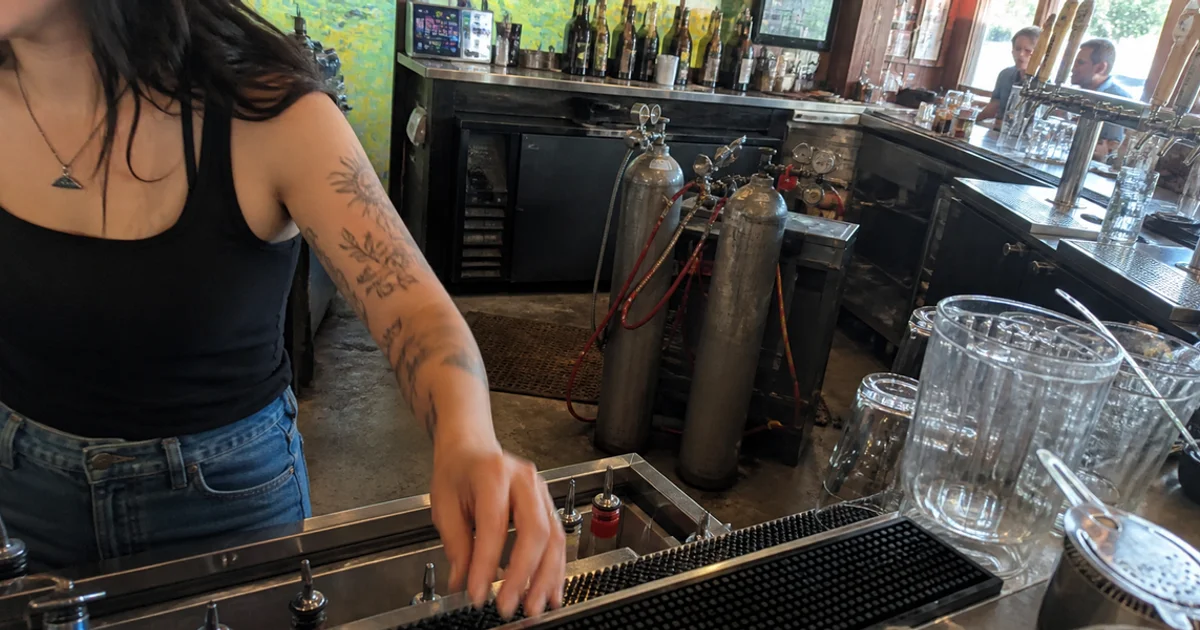
Most operators think of CO2 as the beer gas, which undersells it considerably. In a typical Portland bar or restaurant, CO2 does three jobs.
Carbonation and soda dispensing. Your fountain system mixes CO2-carbonated water with syrup at the gun. No CO2, no soda, no matter how much syrup you have.
Draft beer push. CO2 pressurizes the keg to move beer to the tap while maintaining the carbonation level the brewer intended. Both parts matter; too little pressure and the pour goes flat, too much and it foams.
Specialty applications. Nitro cold brew rigs, carbonated cocktail systems, and some food packaging setups all draw on the same supply.
Which is why an empty cylinder does not slow service down, it stops a whole category of it. Our commercial gas delivery routes exist largely to prevent that specific moment.
Food Grade Is Not Marketing
CO2 comes in different purity grades for different applications. Beverage service requires food-grade gas, which meets purity standards appropriate for anything that contacts a drink.
This is worth being firm about. Industrial-grade CO2 is used for welding, fire suppression, and other applications where trace contaminants do not matter. It is not appropriate for carbonation, and price is not a reason to blur that line. Any supplier serving food and beverage accounts should be supplying food-grade as a matter of course.
Cylinder Sizes and What They Mean Day to Day
| Consideration | Smaller cylinder | Larger cylinder |
|---|---|---|
| Swap frequency | More often | Less often |
| Staff handling | Easier, lighter | Heavier, needs a cart |
| Storage footprint | Smaller | Larger |
| Cost per pound of gas | Higher | Lower |
| Suits | Low volume, tight storage | High volume, adequate space |
The right answer depends on how much room you have and who is doing the swapping. A cellar with a proper cart and a loading route handles large cylinders fine. A cramped back bar with stairs does not.
Once volume gets high and steady enough, the conversation shifts to bulk supply entirely. Our guide on cylinder versus bulk gas delivery covers where that threshold sits.
Storage and Safety
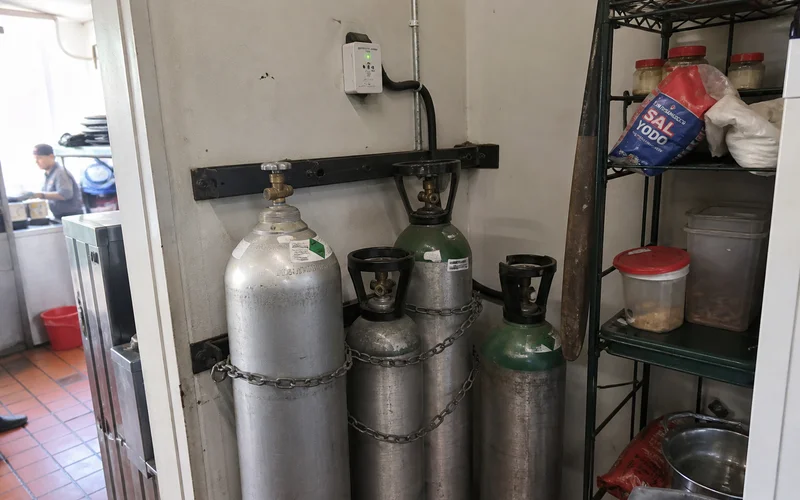
Cylinders store upright, secured so they cannot tip, in a ventilated space, away from heat, and out of high-traffic walkways. A falling high-pressure cylinder is genuinely dangerous, and securing them takes about a minute per cylinder.
Ventilation matters because CO2 is heavier than air. In a sealed basement or a closed walk-in-adjacent closet, a leak displaces oxygen at floor level. This is the reason CO2 monitors exist for enclosed storage areas, and in some spaces they are required.
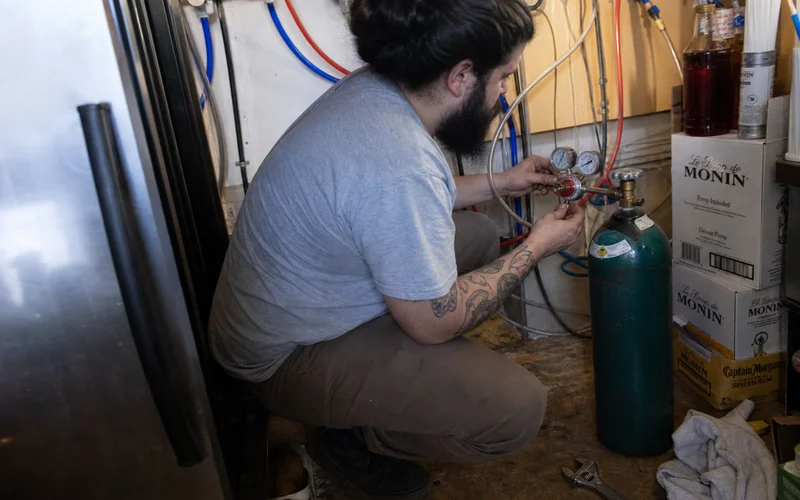
Set your regulators once, then leave them
Draft system pressure should be set for your line length, elevation, and beer style, and then left alone. Bartenders adjusting the regulator to chase a foaming pour usually make it worse and burn extra gas doing it. If pours are consistently wrong, the fix is a system assessment, not a regulator knob.
Refill Cadence Without Guesswork
Tell us kegs poured per week and roughly how many syrup-gallons of fountain soda you go through, and we can estimate monthly consumption closely enough to set a route interval with real margin.
The other half of the answer is a backup cylinder. One spare, staged and ready or connected through a manifold, converts a mid-shift outage from a crisis into a thirty-second swap. Between a properly sized route and one backup cylinder, running dry during service essentially stops happening.
We deliver food-grade CO2 throughout the Portland Metro area and across both river crossings into Clark County, Washington, on scheduled routes with emergency dispatch available when something goes wrong anyway.
Reading Your Gauges Properly
A CO2 regulator normally carries two gauges, and confusing them is a common source of unnecessary emergency calls.
The high-pressure gauge reads cylinder contents. On liquid CO2 it behaves counter-intuitively: it stays roughly flat while liquid remains, then drops fast once the cylinder switches to gas only. That means a gauge sitting comfortably in the middle is not reassurance, it is simply telling you there is still liquid. When it starts falling, you have far less time than the reading suggests.
The low-pressure gauge reads delivery pressure to your system. This is the one that should hold steady at whatever your system was set to. A drifting delivery pressure means a regulator problem rather than an empty cylinder.
Because the high-pressure gauge is a poor early-warning device, weight is a better check on smaller cylinders and a scheduled route is a better answer than either.
Multiple Products, Multiple Pressures
A bar rarely has one correct pressure. Fountain soda, standard draft, and any nitro line all want different settings, and a single regulator cannot serve them well.
A primary regulator sets system pressure from the cylinder, and secondary regulators tune individual lines from there. That arrangement lets you correct one foaming tap without disturbing the others, which is the difference between a targeted fix and a night of guesswork.
If your setup currently runs everything off one regulator and pours vary noticeably by tap, secondary regulators are usually the cheapest improvement available.
Tell us kegs per week and fountain volume and we will size cylinders, cadence, and safety stock to match.