
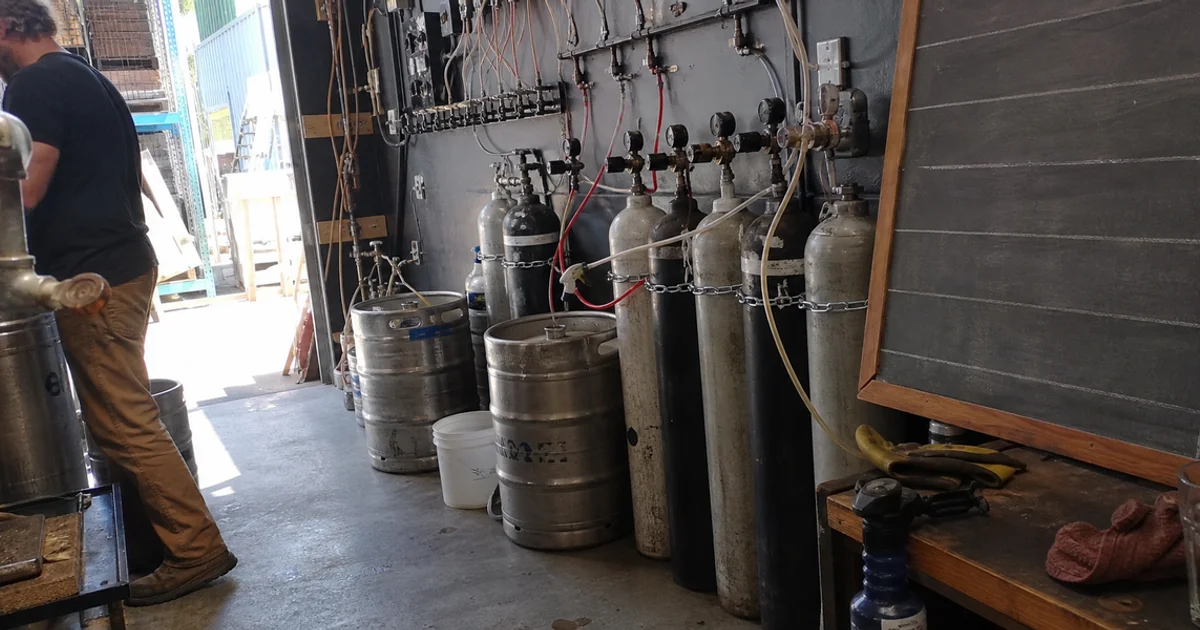
Three Gases, Three Jobs
Beer gas is not one product. Understanding why comes down to a single physical property: how readily each gas dissolves into beer.
Pure CO2 dissolves readily. That is what carbonates beer in the first place, and it is why CO2 is the standard push gas for most draft systems. On a short line from a cold keg to a nearby faucet, pure CO2 at the right pressure holds the beer at its intended carbonation and moves it to the tap. Simple and correct.
Nitrogen barely dissolves at all. It pushes without carbonating. That makes it useless on its own for a standard pour, which needs to keep its carbonation, but essential for nitro pours where the tight creamy head and cascading effect come precisely from nitrogen’s refusal to dissolve.
Blends, most commonly 75/25 nitrogen to CO2, split the difference. Enough CO2 to maintain carbonation, enough nitrogen to deliver push pressure without over-carbonating.
Our commercial gas delivery accounts supply all three across the Portland Metro area, and the right choice depends almost entirely on your draft system layout.

Matching Gas to System
| System | Right gas | Why |
|---|---|---|
| Short draw, keg near tap | Pure CO2 | Low pressure needed, carbonation maintained |
| Long draw to a distant walk-in | 75/25 blend | High push pressure without over-carbonating |
| Elevated taps above the cooler | Blend | Pressure must overcome elevation |
| Nitro stout or nitro coffee | Nitrogen or nitro blend | Cascade and dense head require nitrogen |
| Fountain soda | Pure CO2 | Carbonation is the entire point |
| Cask or hand pull | None, or minimal | Traditional dispense uses no gas push |
The dividing line is line length and pressure. A short-draw system needs only enough pressure to maintain carbonation and move beer a few feet. A long-draw system running to a remote walk-in needs substantially more pressure to overcome line resistance, and at that pressure pure CO2 will over-carbonate the beer sitting in the line.
What Wrong Gas Looks Like in the Glass
Foaming on every pour with pure CO2 on a long line usually means over-carbonation from excess pressure. The gas keeps dissolving into stationary beer in the line between pours.
Flat pours mean too little pressure, or a blend with too little CO2 for the style.
A nitro faucet producing ordinary foam means CO2 where nitrogen should be.
Inconsistent pours across taps on a shared regulator usually means one line needs different pressure than the others, which is a manifold and secondary regulator question rather than a gas question.
Check the easy things first
Before changing gas, confirm your beer lines are properly chilled along their entire run, that they have been cleaned on schedule, and that faucet type matches the pour. Warm or dirty lines produce foam no gas blend can fix, and they are far more common than a gas selection error.
Regulators, Manifolds, and Pressure
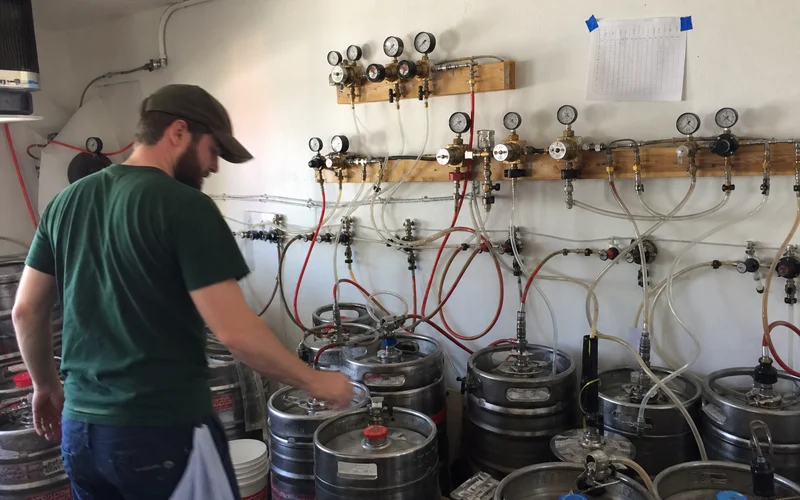
A primary regulator sets system pressure off the cylinder. Secondary regulators let you tune individual product lines, which matters when you are pouring styles that want different pressures off one gas source.
A manifold lets multiple cylinders feed one system, so swapping an empty does not interrupt service. For any bar running significant volume, a manifold plus a backup cylinder is the single most effective anti-outage setup available.
Set pressure deliberately for your system, then leave it alone. Regulators adjusted nightly by whoever is closing produce inconsistent pours and burn gas.
Getting the Blend Right for Your Bar
Tell us your line lengths, elevation from keg to tap, what styles you pour, and whether you run nitro. That is enough to specify the blend and pressure your system should be on.
For non-beverage applications, our guide on nitrogen, argon, and specialty gas covers purity grades and industrial uses.
Blend Ratios and What Sits Behind Them
The 75/25 label refers to the nitrogen-to-CO2 ratio by volume, and it is a convention rather than a law. Other ratios exist and are used deliberately.
A higher CO2 fraction suits shorter lines and styles that want more carbonation held in the glass. A higher nitrogen fraction suits very long runs, high elevation between cooler and tap, and styles where a softer carbonation reads better. Nitro-specific pours sit at the extreme end, effectively all nitrogen.
The ratio you need is a function of your system rather than your taste. Line length, internal diameter, vertical rise from keg to faucet, and cooler temperature together determine the pressure required to deliver beer at the right speed. Once you know that required pressure, the blend is chosen so the CO2 partial pressure within it matches the carbonation the beer should hold. Push harder than that with pure CO2 and you carbonate the beer further in the line; push softer and it goes flat.
Most Portland bars we set up land on either pure CO2 for a short-draw system or a standard nitrogen-heavy blend for long-draw. The unusual ratios are worth discussing only when something about your system is genuinely unusual.
Storage, Handling, and Swapping
Blend cylinders store the same way as CO2: upright, secured against tipping, ventilated, away from heat, and out of walkways. Keep full and empty clearly separated so nobody connects an empty during service.
Label which regulator feeds which product line. In a cellar running pure CO2 for soda and a blend for draft, mixing the two up is easy to do at speed and produces a confusing pour problem that takes a while to trace back to the gas.
Tell us your line lengths, rise, and style mix and we will specify the blend and pressure your system should run.