
The First Two Minutes
An empty cylinder mid-service is not a maintenance issue, it is a revenue issue. Draft and fountain service stop until gas is restored.
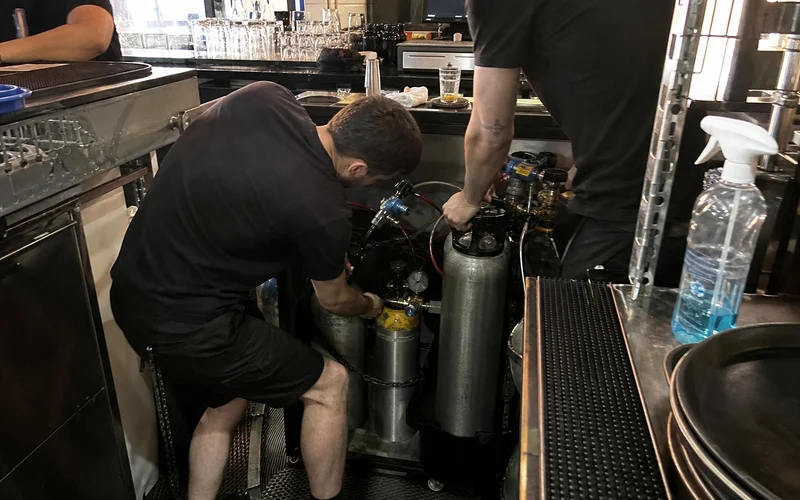
Confirm it is actually empty. Check the high-pressure gauge on the regulator, not just the pour. A regulator that has drifted, a closed valve, or a kinked line can produce the same symptom as an empty cylinder and takes seconds to rule out.
Check for a backup. If you have a spare cylinder or a manifold with a second bottle, switch over now. This is the entire reason safety stock exists.
Call for emergency delivery. Have your address, gas type and blend, cylinder size, and quantity ready. Our commercial gas delivery team can dispatch across the Portland Metro area, and the call takes under a minute if you have those details in hand.
Tell the floor. Bar staff who know soda and draft are down for a while can steer guests toward bottles, cans, wine, and spirits instead of taking orders they cannot fill.
What You Can and Cannot Substitute
| Situation | Safe temporary option |
|---|---|
| Out of 75/25 blend, standard draft | Pure CO2 will pour, may over-carbonate on long lines |
| Out of CO2, nitro system only | Nothing, nitro needs nitrogen |
| Out of CO2, fountain soda | Nothing, carbonation requires CO2 |
| Out of beverage gas, industrial cylinder on hand | Never, industrial grade is not for beverage use |
That last row is worth being blunt about. Whatever the pressure of the moment, industrial-grade gas does not go into a beverage system. Call instead.
What Emergency Delivery Involves
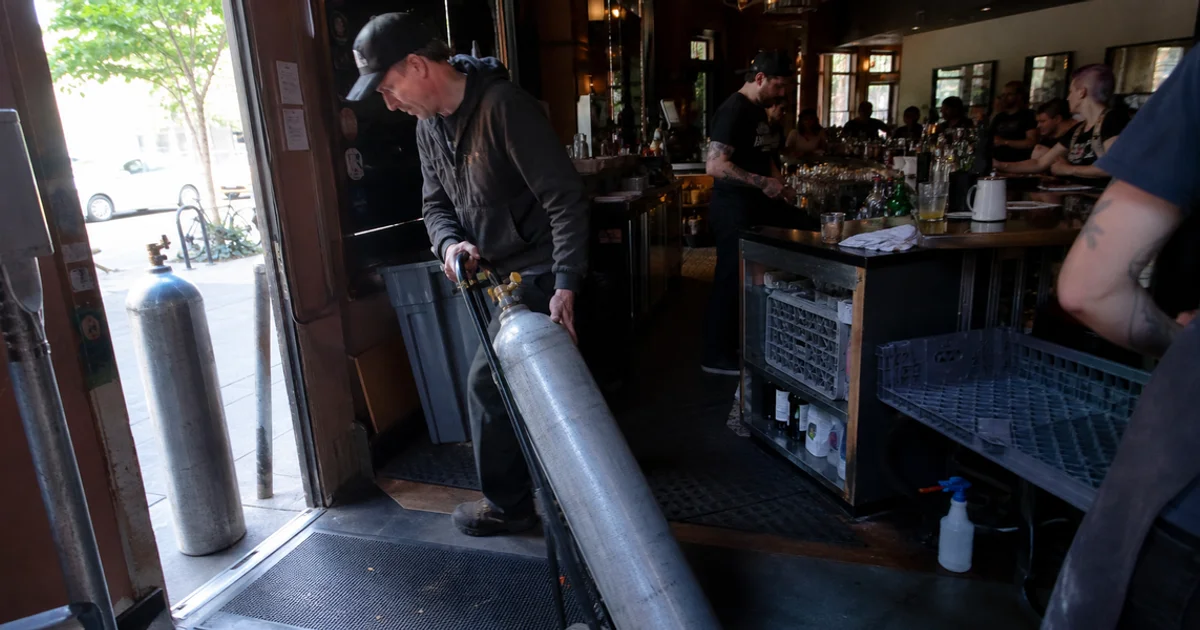
We route a driver with the gas you need, they bring it in, swap the cylinder, and confirm the system comes back up. Emergency delivery carries a different rate than a scheduled drop, because it is an unplanned stop outside route timing, often after hours.
The rate is not the real cost though. The real cost is the hour or two of stopped service before the driver arrives, which is why the rest of this guide is about preventing the situation rather than responding to it.
The single highest-value change
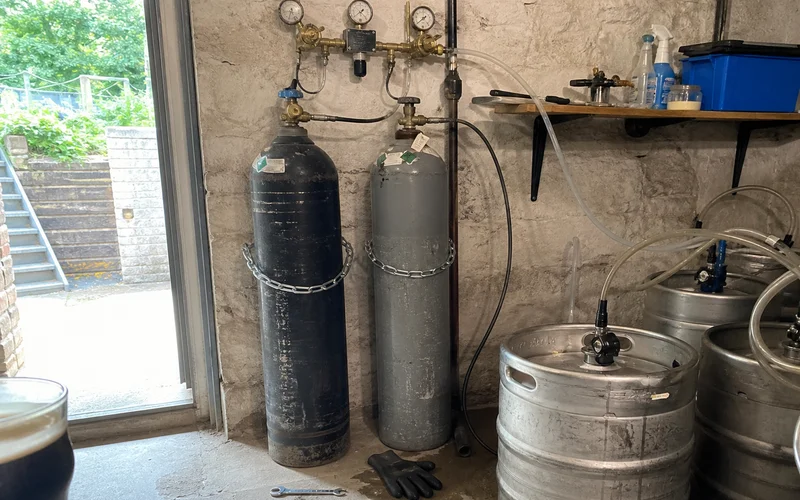
One backup cylinder. Connected through a manifold so the changeover is automatic, or simply staged and ready so it is a thirty-second swap. Almost every operator who has run dry mid-shift adds one afterward, and almost none of them run dry again.
Setting Up So It Stops Happening
Get on a scheduled route sized to your real usage. Tell us kegs per week and fountain volume and we estimate consumption, then set an interval with margin so cylinders get swapped before anybody is watching a gauge. How that cadence gets set, and what it costs, is covered in gas delivery scheduling and pricing.
Hold safety stock. One spare minimum. Two if you run high volume or if a weekend gap in delivery availability could catch you out.
Check gauges on a schedule. Add it to the closing checklist. Ten seconds a night is enough to notice a bottle getting low.
Watch for seasonal spikes. December volume can be dramatically higher than November. Tell us ahead and we adjust the route rather than reacting after the fact.
If you would rather set this up properly than manage it reactively, get in touch and we will size a route and a safety-stock plan for your operation.
Why Cylinders Empty Sooner Than Expected
Running dry between scheduled drops usually has a specific cause rather than being bad luck.
Volume went up and nobody said. A new nitro line, an extra soda station, a busier season, or a beer festival weekend. Consumption changed and the route did not.
A leak. This is more common than operators think and it is the reason for an unexplained jump in usage. Gas escaping at a fitting or a failed regulator diaphragm empties a cylinder quietly and continuously. Soapy water brushed onto fittings finds most leaks in ten minutes, and it is worth doing whenever consumption climbs without an obvious reason.
Pressure set too high. A system running at higher pressure than it needs uses more gas per pour and over-carbonates the product while doing it. Two problems, one cause.
Somebody left a valve open. On a system with a manifold, an open valve to a disconnected line vents continuously.
If you have run out twice in a season, the fix is diagnosis rather than more frequent delivery.
Making the Call Efficient
When you do have to call, the details that speed dispatch are consistent: business name and address, gas type and blend, cylinder size and fitting, quantity needed, where the driver parks and which door to use, and a phone number that will actually be answered during service.
Keeping that written on a card near the regulators means whoever is on shift can make the call correctly without hunting for information.
Better still, get in touch before it happens and we will size a route and safety stock so it does not.