
What “Not Cooling” Actually Means
A walk-in cooler that is not holding temperature is not one problem, it is a category. The system might be dead. It might be running perfectly and unable to remove heat. It might be cooling fine while warm air pours in through a failed gasket faster than it can be removed.
Those look identical from the doorway and require completely different fixes. That is why the first thing our dispatch team asks about is what the system is doing, not just what the thermometer says.
The most common causes we find on commercial refrigeration repair calls in Portland kitchens, roughly in order:
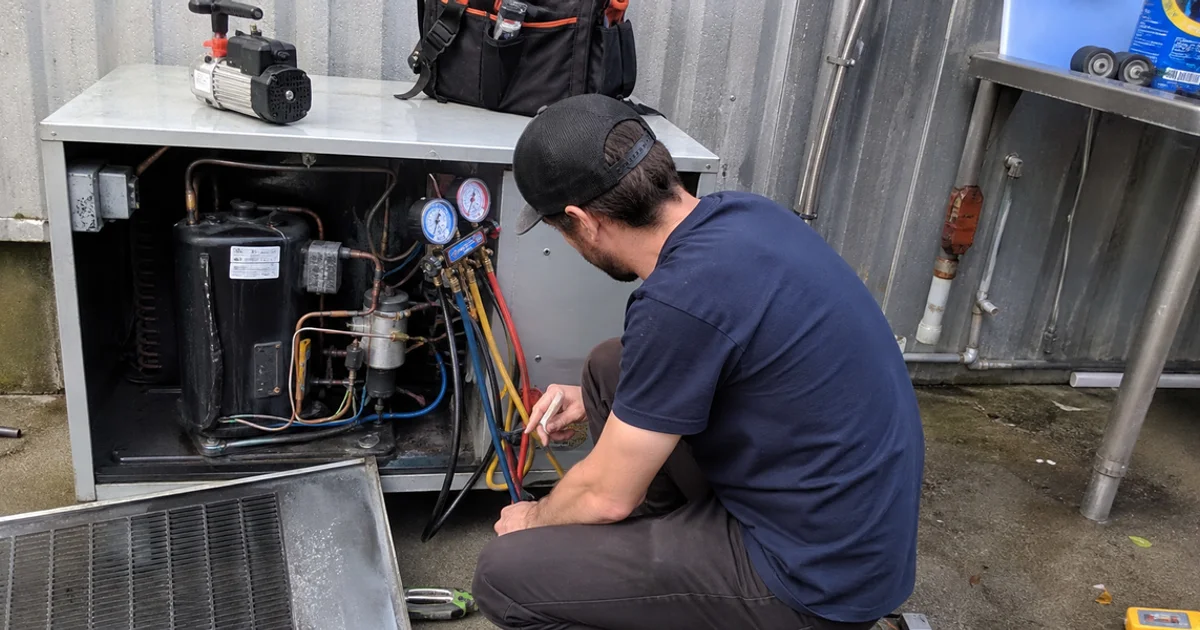
Dirty or blocked condenser. The condenser rejects heat. Pack its fins with grease, dust, and lint and the system cannot get rid of the heat it collects. Head pressure climbs, the compressor runs continuously or trips on its safety, and the box drifts warm. This is the single most common cause, and it is entirely preventable.
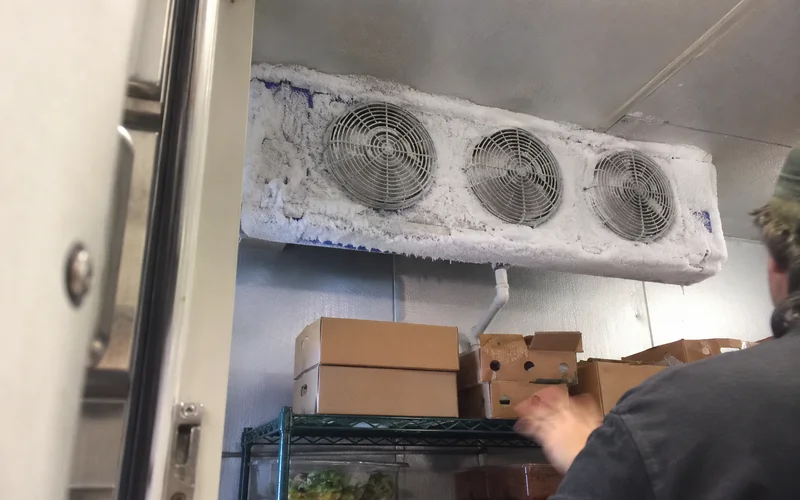
Iced evaporator coil. If the coil inside the box is bridged over with frost, air stops moving through it. No airflow means no heat transfer, so the system runs hard and cools nothing. Ice on the coil almost always means a defrost problem: a failed heater, a drifted defrost termination sensor, or a control that ends the cycle early.
Failed thermal expansion valve (TXV). The TXV meters refrigerant into the evaporator. When it loses control, superheat goes wrong and cooling capacity collapses, often gradually enough that the box just sits a few degrees warm for weeks before anyone notices.
Low refrigerant charge. Refrigerant does not get consumed, so low charge means a leak. Symptoms include long run times, poor pull-down, and sometimes frost forming at the wrong place on the line.
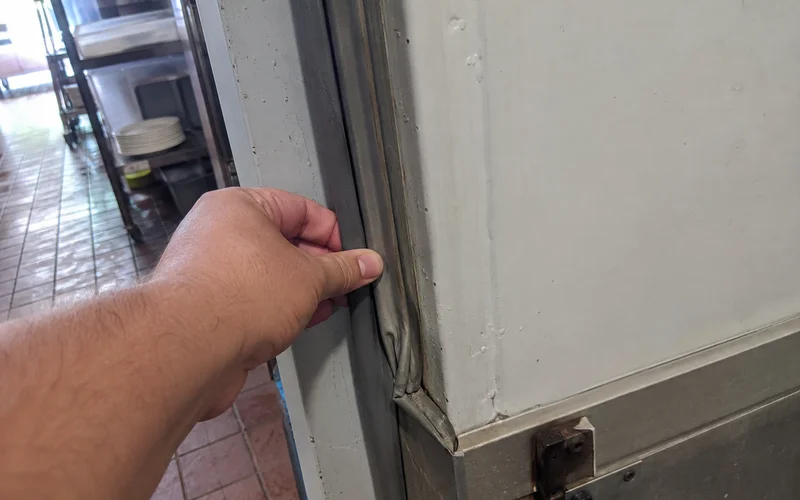
Worn door gaskets. A flattened or torn gasket lets warm, humid kitchen air in continuously. In summer that load alone can keep a healthy system from ever reaching setpoint, and the moisture it carries in ices the coil.
Electrical faults. Failed contactors, burnt relays, tripped breakers, or a defrost timer stuck in defrost. Cheap parts, big consequences.
Safe Checks Before You Call
You can do these yourself in about five minutes, and they occasionally solve the problem outright.
- Confirm the door is fully latched and the gasket is seated. Check the whole perimeter, not just where you can see easily.
- Look at the condenser. If it is visibly packed with grease and lint, that is your answer, or a large part of it.
- Check the thermostat setting. Someone bumps it more often than anyone admits.
- Look inside at the evaporator. Heavy frost across the coil means a defrost issue.
- Confirm the evaporator fans are running when you open the door and hold the door switch.
- Check the breaker and disconnect. A tripped breaker is a two-second find.
- Make sure product is not blocking airflow in front of the evaporator.
Do not go past this point
Anything involving refrigerant, sealed components, or electrical work inside the unit needs an EPA Section 608 certified technician. Attempting it yourself risks injury, voids warranties, and frequently turns a moderate repair into an expensive one.
What to Do About the Product
While you are troubleshooting, someone else should be protecting inventory. Get a probe thermometer into actual product, not just the air, because the food-safety clock runs on product temperature. Write down times and readings as you go.
Move the most sensitive items, dairy, raw protein, prepared foods, into working reach-ins or a neighboring cold box in the first hour. That is when the decision is easy and the product is still fine. Three hours in, you are making disposal judgments instead.
Keep the door shut otherwise. Every open cycle costs you.
When to Stop Troubleshooting and Call
Call immediately if the box is above 41°F and climbing, if the coil is solidly iced, if you smell anything burning, if a breaker trips repeatedly, or if the compressor is short-cycling audibly. Those are not wait-and-see situations with inventory on the line.
Our emergency line runs 24/7 across the Portland Metro area and SW Washington precisely because refrigeration fails during service and overnight, not during office hours.
Most of what causes a walk-in to stop cooling is preventable. Dirty condensers, worn gaskets, and drifted defrost sensors are all things a quarterly maintenance visit catches while they are still cheap. If you are having this conversation more than once a year, the equipment is telling you something about your maintenance schedule, and preventive maintenance agreements for commercial kitchens covers what that scheduling actually looks like.
Seasonal Patterns Worth Recognising
If the problem appears in warm weather and eases in cool weather, that is a strong diagnostic signal on its own.
Refrigeration systems reject heat into the surrounding air. On a mild day, a condenser that is partly blocked still manages. On a hot afternoon, the reserve capacity that was covering for it disappears, and the box drifts. Then it recovers overnight when ambient temperature falls, which makes the problem look intermittent when it is actually constant and only visible under load.
The same logic applies to a kitchen that gets hotter as service progresses. A walk-in holding fine at 10 AM and drifting at 7 PM is usually telling you about condenser condition, airflow around the unit, or a system with no margin left rather than about a component that fails at dinner time.
The fix is almost always the same: clean the condenser, confirm clearances around it, and address whatever is stealing the system’s reserve.
After the Repair, Ask What Caused It
When the technician has the box holding temperature again, ask two questions before they leave.
What actually failed, and why? A defrost sensor that drifted is a component failure. A compressor that died because the condenser had not been cleaned in two years is a maintenance failure, and it will happen again on your other equipment.
What else on this unit is close? A technician who has just had the panels off has seen the state of everything in there. That is the cheapest information you will get all year.
Write the answers down. Over time they tell you which equipment is aging out.